How to Implement Role-Based Access Control (RBAC) in Next.js
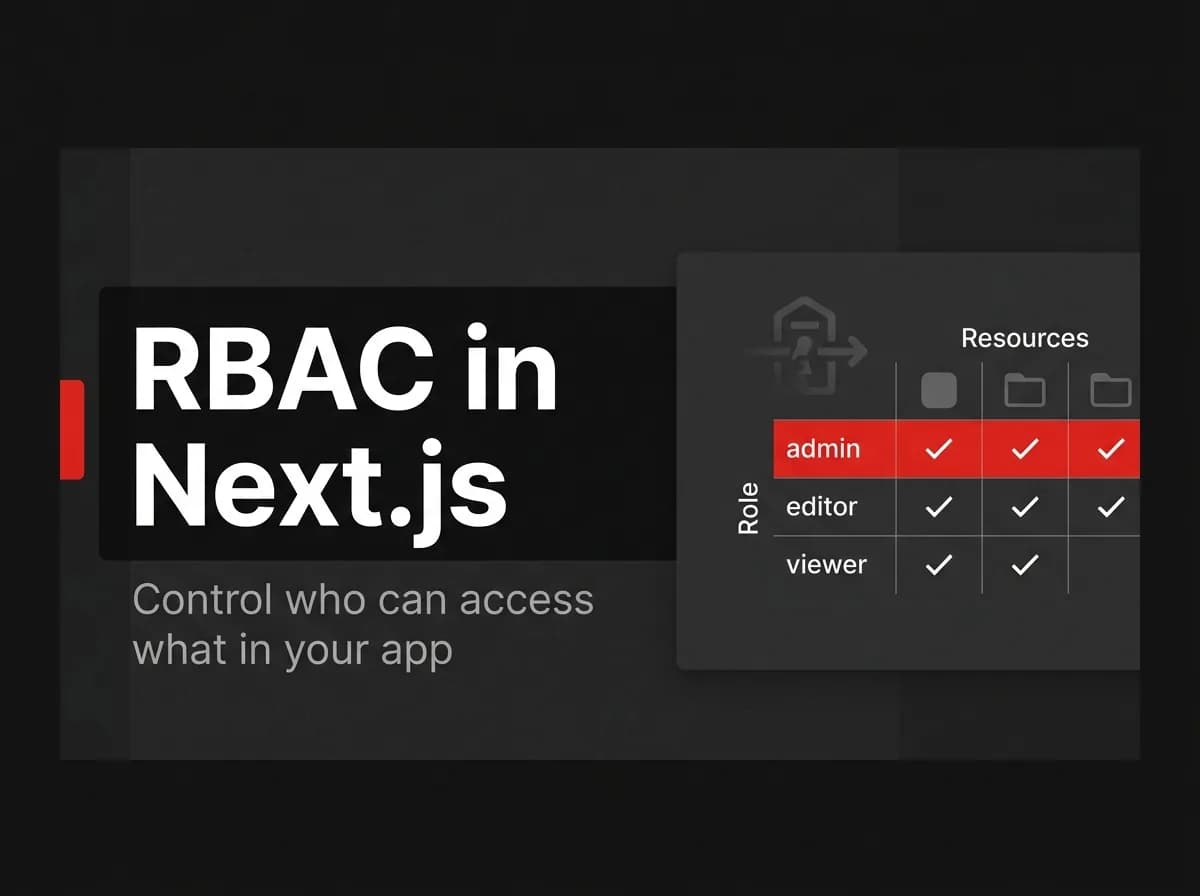
Role-Based Access Control (RBAC) in Next.js is one of those auth topics that sounds simple until you're arguing about whether to check the role or the permission. Here's the short answer: always check the permission. A well-modeled RBAC system is data-driven, so adding a new role never means updating checks across the codebase. Here's the full implementation.
Quick Answer
To implement RBAC in Next.js, model roles and permissions in your database, assign roles to users, then check the user's permissions on the server before any protected action — with a fast coarse check in middleware for redirects. Keep permissions data-driven (a role maps to a set of permissions) so adding a role never means rewriting checks across the app.
Roles vs permissions
Authentication asks "who are you?"; authorization asks "what may you do?". RBAC answers the second: a user has one or more roles, and each role grants a set of permissions. Check the permission, not the role name, so logic stays flexible.
Model the data
Entity | Purpose |
|---|---|
Role | A named bundle (owner, admin, member) |
Permission | A granular capability (e.g. |
RolePermission | Which permissions a role grants |
UserRoleAssignment | Which role(s) a user has |
Assign roles
When a user joins (or a workspace invites them), assign a role. An owner/admin can change roles later. Store assignments in the database so they are auditable and editable without a deploy.
Enforce in middleware and on the server
// (untested-here) server-side permission check
export function requirePermission(user: User, permission: string) {
  if (!user.permissions.includes(permission)) {
    throw new Error('Forbidden');
  }
}
Use middleware for a fast "is this user allowed near this area?" redirect, and always re-check the specific permission in the server code that performs the action — see protect routes with middleware.
Owner and admin tiers
Most SaaS need a top tier (owner) that can do anything, an admin tier, and a member tier. Make the owner role explicit and protected so it cannot be removed accidentally.
How this maps to FastStaq
FastStaq ships real RBAC: a UserRole enum plus UserRoleAssignment, Permission, and RolePermission models, with OWNER as the highest role. A create-admin CLI sets the role, assignments, and an audit entry. So the data-driven model described here is built in. Combined with multi-tenant workspaces, you get per-workspace roles out of the box. See multi-tenant SaaS architecture and the Next.js authentication guide.
Frequently asked questions
Should I check the role or the permission? Check the permission — it keeps your code stable when roles change.
Where do I enforce RBAC? In middleware for coarse redirects and again in the server action or route that performs the action.
Is RBAC enough for multi-tenant apps? Pair RBAC (what a user can do) with tenant scoping (which workspace they belong to) — see the multi-tenant guide.