Next.js vs Nuxt - React vs Vue for Your SaaS
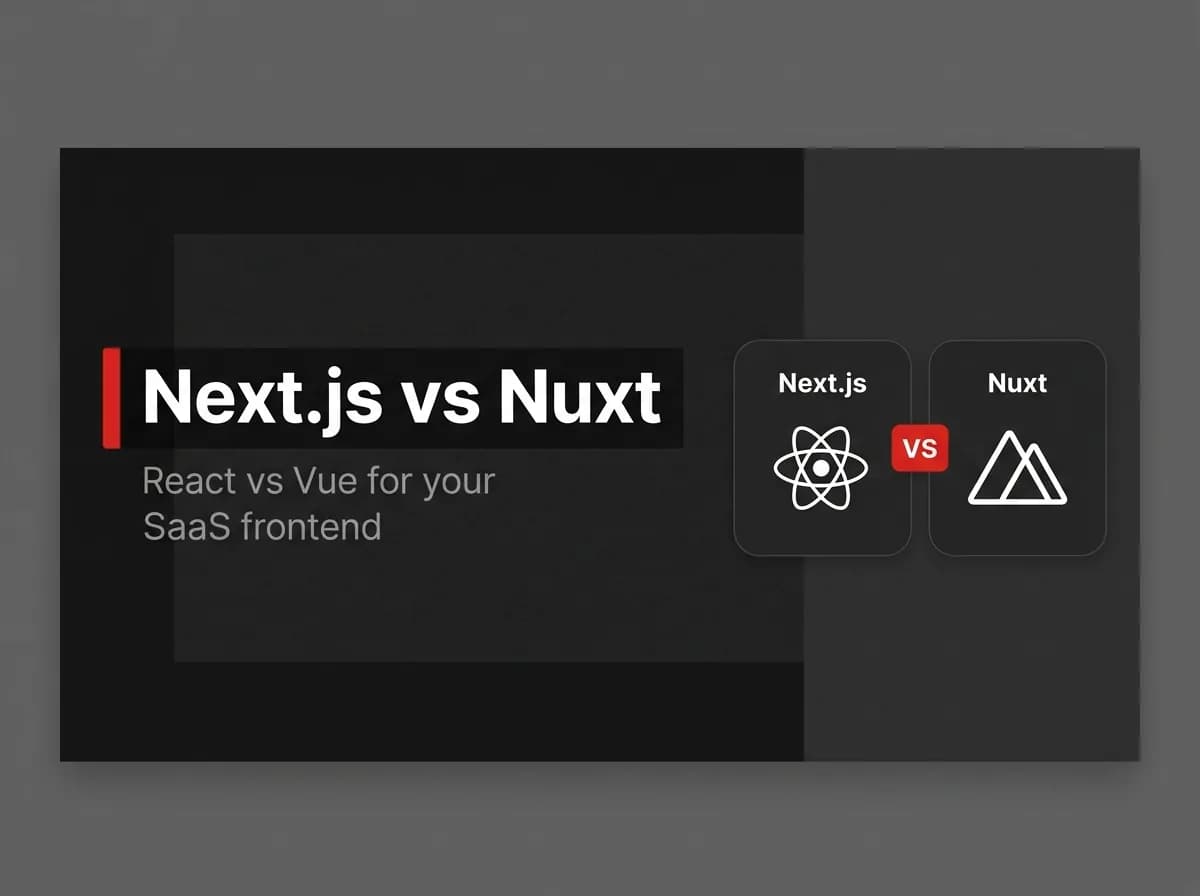
Next.js vs Nuxt is really React vs Vue — and that's the honest way to frame the decision. Both are mature, full-featured meta-frameworks with server rendering, file-based routing, and strong developer experience. Feature parity is close enough that the deciding factor is almost always the front-end ecosystem your team already knows. Here's the breakdown.
Quick Answer
Choose Next.js if your team prefers React and wants the largest ecosystem and hiring pool; choose Nuxt if your team prefers Vue. Both are mature, full-featured meta-frameworks with server-side rendering, file-based routing, and excellent developer experience — so the deciding factor is usually React vs Vue and the skills your team already has.
The core difference: React vs Vue
Next.js is built on React; Nuxt is built on Vue. Everything else — rendering, routing, data fetching — is broadly comparable. So this choice is mostly a choice between two front-end ecosystems and the developers you can hire or already have.
At a glance
Dimension | Next.js | Nuxt |
|---|---|---|
Base framework | React | Vue |
Rendering | SSR, SSG, ISR, streaming | SSR, SSG, hybrid |
Routing | File-based (App Router) | File-based |
Ecosystem size | Very large | Large |
Hiring pool | Largest (React) | Large (Vue) |
Best for | React teams, max ecosystem | Vue teams |
(Both frameworks evolve — verify current feature parity before deciding.)
Ecosystem and hiring
React has the larger ecosystem and the deeper hiring pool, which matters when you scale a team or look for libraries and examples. Vue is loved for its approachable API and clean single-file components. If you have no existing preference, the React ecosystem is the safer bet for a SaaS you plan to grow.
Rendering and features
Both support server rendering, static generation, and hybrid approaches, with strong data fetching and routing. For most SaaS apps either will meet your technical needs — feature parity is close enough that team fit dominates.
When Nuxt wins
If your team is already productive in Vue, Nuxt is the obvious choice — forcing a React switch would cost more than any framework difference. Vue's ergonomics are a genuine advantage for teams that prefer them.
Which to choose?
Choose Next.js if: you prefer React, want the biggest ecosystem, or plan to hire widely.
Choose Nuxt if: your team prefers Vue.
How this maps to FastStaq
FastStaq is built on Next.js (React), chosen for the ecosystem and hiring depth described above. That is our pick — but if your team is a Vue shop, Nuxt is a perfectly good foundation; the FastStaq stack simply standardizes on React. See Next.js vs Remix and what a SaaS boilerplate is.
Frequently asked questions
Is Next.js better than Nuxt? Not universally — Next.js wins on React ecosystem and hiring; Nuxt wins for Vue teams. Pick based on your team's skills.
Can I build a SaaS with either? Yes — both are production-grade meta-frameworks suitable for a SaaS.
Which does FastStaq use? Next.js (React).
Next steps
Read Next.js vs Remix
Compare the best Next.js boilerplates
Comparing SaaS boilerplates?
Get the SaaS Production Readiness Checklist, the 20 things any boilerplate has to get right before launch, plus a 6-part walkthrough of each one. One email to start, unsubscribe anytime.