MongoDB vs PostgreSQL - Which to Choose for SaaS
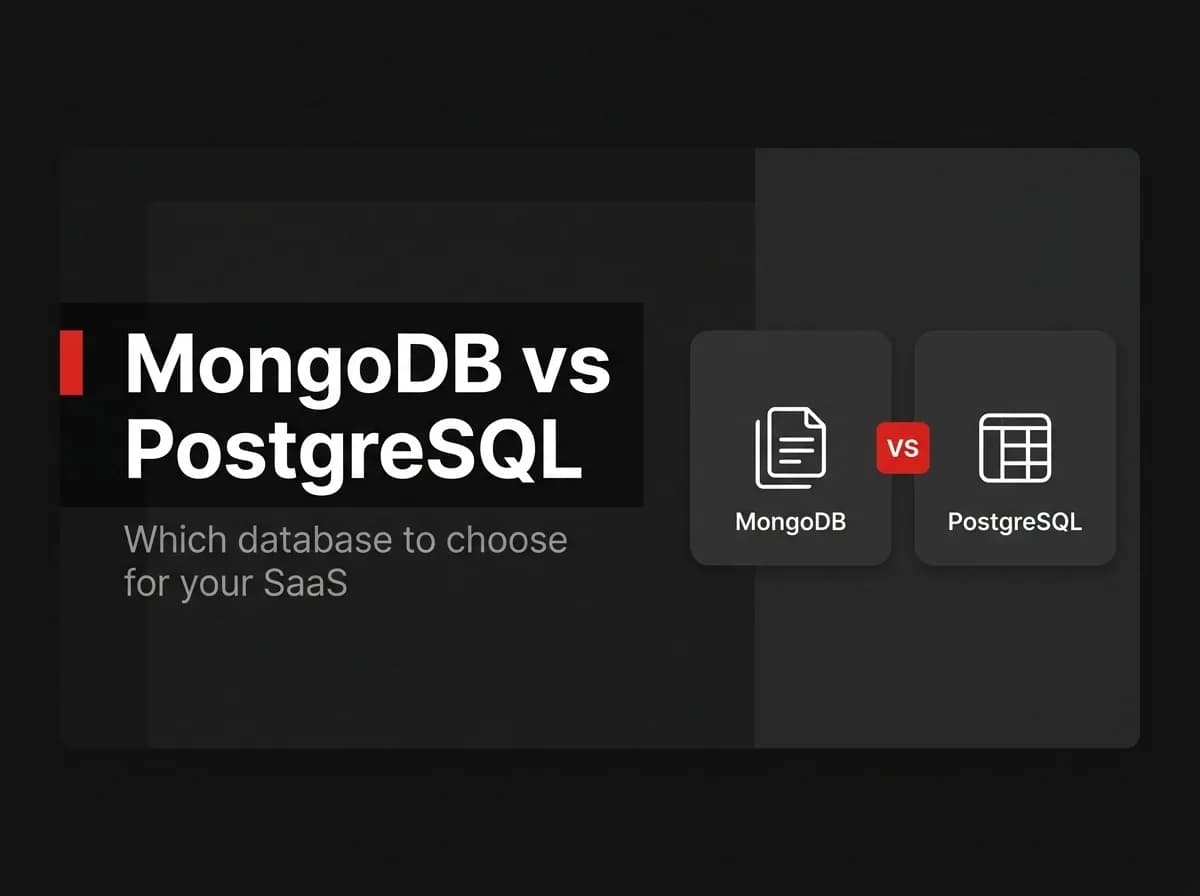
MongoDB vs Postgres is the first real infrastructure decision most SaaS founders face. Get it wrong and you're rewriting your data layer six months in, usually right when you can least afford to.
Quick answer
For most SaaS products, default to PostgreSQL. It handles relational data, transactions, and JSON in the same database, which covers what a typical app (users, workspaces, subscriptions, billing events) actually needs. Reach for MongoDB when your data is genuinely document-shaped and needs to scale horizontally in ways a relational schema resists. If you're unsure, Postgres is the safer starting point because it does both relational and document-style storage.
MongoDB vs Postgres: the core difference
PostgreSQL is a relational database. Data lives in tables with defined columns, rows relate to each other through foreign keys, and the database enforces that structure at write time. MongoDB is a document database. Data lives in collections of JSON-like documents (BSON, technically), and each document can have a different shape from the next.
That one distinction drives almost every other tradeoff below. Relational databases assume your data has structure and relationships worth enforcing. Document databases assume your data is naturally self-contained and that flexibility matters more than upfront structure.
Comparison table
Dimension | PostgreSQL | MongoDB |
|---|---|---|
Data model | Relational: tables, rows, foreign keys | Document: collections of JSON-like documents |
Schema | Defined upfront, enforced by migrations | Flexible by default, optional validation rules |
Transactions | ACID across tables, built in | Multi-document ACID transactions, supported since MongoDB 4.0 |
Joins | Native, via SQL | Limited ( |
JSON storage | Native via the | Native, documents are JSON-like by default |
Full-text search | Built in ( | Built in (text indexes, Atlas Search) |
Horizontal scaling | Requires an extension or managed service for sharding | Native sharding built into the database |
Best fit | Structured, relational data: users, orgs, billing, permissions | Loosely structured, high-volume data: logs, catalogs, event streams |
FastStaq default | Yes, via Prisma | Not used |
When Postgres wins
Postgres is the better call whenever your data has real relationships you'll query across. A SaaS app is mostly this: a user belongs to a workspace, a workspace has a subscription, a subscription generates invoices, an invoice has line items. Every one of those is a foreign key relationship, and you'll write queries that join across two or three of them constantly (show me all overdue invoices for workspaces on the Pro plan, for example).
Pro tip: if you're unsure whether your data is "document-shaped," ask whether you'd ever need to join it against another entity. If the answer is usually yes, that's a vote for Postgres.
Postgres also wins when you need transactional integrity across multiple tables. Charging a card, decrementing a seat count, and writing an invoice row should either all succeed or all fail together. That's a native transaction in Postgres. In MongoDB it's a supported feature since version 4.0, but it's explicitly positioned as something you reach for in specific cases rather than the default way of writing data.
FastStaq, for example, defaults to Postgres through Prisma across all 76 of its data models: users, workspaces, subscriptions, webhooks, affiliate payouts, and more. That's a lot of relational structure (foreign keys between users and workspaces, workspaces and subscriptions, subscriptions and invoices), and Postgres handles it without extra tooling. You can point it at any managed Postgres host, including Supabase's or Neon's, just by setting DATABASE_URL.
Note: Postgres's
jsonbcolumn type stores schema-flexible data inside an otherwise relational database. A common pattern is keeping the 10 to 20 percent of fields that genuinely vary (custom metadata, feature flags, form responses) in ajsonbcolumn while the rest of the schema stays relational.
When MongoDB fits
MongoDB makes sense when your data is genuinely document-shaped and you don't need to join it against much else. A few real scenarios:
Content catalogs with wildly different attributes per item. A product catalog where each item has 5 to 50 unique fields depending on category doesn't map cleanly to fixed columns.
High-volume event or log ingestion. Write-heavy, read-light data (analytics events, audit trails) doesn't need relational integrity as much as it needs fast writes and horizontal scale.
Schemas that genuinely change week to week. Very early-stage products where the data shape is still being figured out can benefit from not running a migration every time a field changes.
Teams already running MongoDB at scale. If you have existing sharding infrastructure and operational expertise, the migration cost to Postgres may not be worth it.
The tradeoff: you give up native joins and take on more responsibility for data consistency at the application layer. That's a fair trade for the right workload. It's a bad trade for a typical SaaS app's core relational data (users, billing, permissions), where you'd end up rebuilding joins and referential integrity checks in application code that the database would otherwise handle for you.
FAQ
Can PostgreSQL store JSON like MongoDB does? Yes. Postgres has a native jsonb column type that stores and indexes JSON data directly. It's not a full document database, but it covers the common case of needing flexible fields inside an otherwise structured schema, and it's queryable with the same SQL you use for the rest of your data.
Does MongoDB support transactions across multiple documents? Yes, MongoDB has supported multi-document ACID transactions since version 4.0, including across collections and sharded clusters. MongoDB's own documentation notes that because related data is often embedded within a single document, many applications don't need multi-document transactions for common cases, and treats them as a tool for specific situations rather than the default write pattern.
Which is faster, MongoDB or PostgreSQL? Neither is categorically faster. Performance depends on your schema, indexes, query patterns, and hosting setup far more than the database engine itself. A well-indexed Postgres table and a well-indexed MongoDB collection perform similarly for most SaaS workloads; the real difference shows up in how naturally each one handles your specific data shape.
Can I migrate from MongoDB to PostgreSQL later? Yes, but it's real engineering work, not a config change. You'll need to design a relational schema, write a migration script, and update every query in your application layer. It's far cheaper to pick the right database up front than to migrate a production app with live user data.
What database does FastStaq use? FastStaq uses PostgreSQL through Prisma across all of its data models, and it works with any Postgres host, including managed options like Supabase or Neon.
Where to go next
Most SaaS apps are relational at their core: users, workspaces, subscriptions, and the relationships between them. That makes Postgres the right default, with MongoDB reserved for the specific parts of your product (catalogs, logs, event streams) that are genuinely document-shaped.
If you're setting up Postgres with Prisma, the next practical step is your migration workflow. See our guide on Prisma migrations for how to structure schema changes as your app grows. If you also need search, full-text search with PostgreSQL covers tsvector setup without adding a separate search service.
If you want the schema already wired up, FastStaq ships all 76 data models on Postgres and Prisma, so you're not building the users-workspaces-subscriptions structure from scratch.
Comparing SaaS boilerplates?
Get the SaaS Production Readiness Checklist, the 20 things any boilerplate has to get right before launch, plus a 6-part walkthrough of each one. One email to start, unsubscribe anytime.