Vercel vs Railway - Where to Deploy Your SaaS
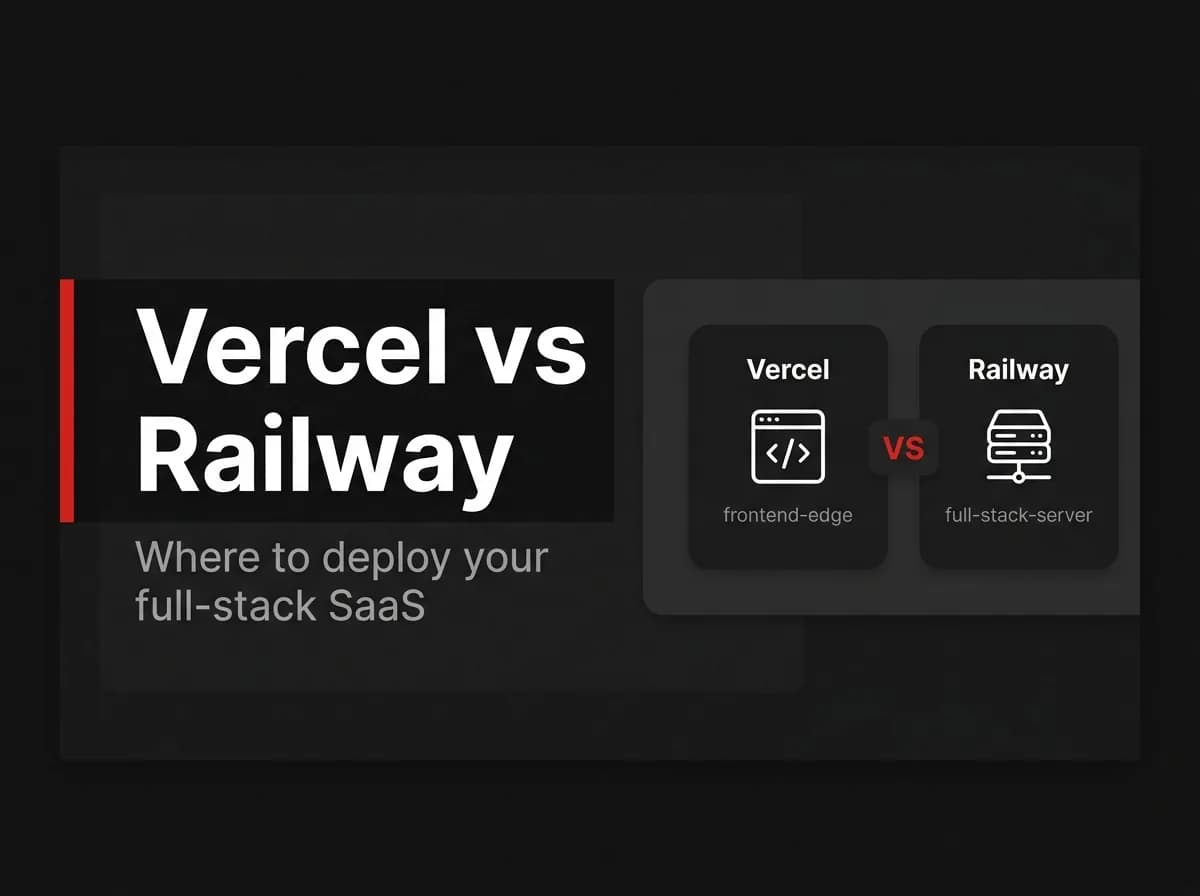
Vercel vs Railway looks like a frontend hosting comparison — but it is really a question about where your API, background workers, and database run. Vercel is brilliant for Next.js frontends and serverless functions. Railway is a full-stack PaaS that runs long-lived services, workers, and managed databases in one place. Many teams use both. Here's how to decide.
Quick Answer
Choose Vercel to host a Next.js frontend with serverless/edge functions and the best Next.js developer experience. Choose Railway when you need to run a full-stack app — a long-running API server, background workers, plus Postgres and Redis — in one place. Many teams use both: Vercel for the frontend and Railway for the backend services and database. The deciding question is "where do my API, workers, and database run?"
The key difference: frontend host vs full-stack PaaS
Vercel is optimized for front-end frameworks (especially Next.js) and serverless functions. Railway is a full-stack PaaS that runs long-lived services, background workers, and managed databases. Vercel is brilliant for the front end; Railway can host the whole application.
At a glance
Dimension | Vercel | Railway |
|---|---|---|
Best at | Next.js frontend + serverless | Full-stack apps |
Long-running server | No (serverless functions) | Yes |
Background workers | Not designed for it | Yes |
Managed Postgres / Redis | Via integrations | Built in |
Cron / queues | Limited | Yes |
Best for | Front end + edge | API + workers + DB together |
(Capabilities and pricing change — verify with each host before committing.)
What runs where
A full SaaS often has four parts: a front end, an API server, background workers, and a database (often plus Redis). Vercel handles the front end and serverless functions beautifully but is not built to host a long-lived API server or workers. Railway can run all four. That is why the common pattern is "Vercel front, Railway back."
Databases, Redis, and cron
Railway provides managed Postgres and Redis and can run scheduled jobs and workers next to your app. On Vercel you would attach external services for these. If your app leans on background processing and a database you control, a full-stack PaaS simplifies the setup.
Which to choose?
Choose Vercel if: your app is mostly a Next.js front end with serverless functions.
Choose Railway if: you run a long-lived API, workers, Postgres, and Redis together.
Use both if: you want Vercel's frontend DX with a full backend hosted on Railway.
How this maps to FastStaq
FastStaq is a Dockerized monorepo: a Next.js client, a dedicated Express API, and BullMQ workers, backed by Postgres and Redis. Its backend needs a host that runs long-lived services — which a full-stack PaaS like Railway provides, or self-hosted Docker. You can still serve the Next.js front end on Vercel and run the backend on Railway. Because FastStaq ships a production Dockerfile, it deploys to either model. See Railway vs Render, Best Vercel alternatives, and how to Dockerize a Next.js app.
Frequently asked questions
Can you host a backend on Vercel? You can run serverless functions, but not a long-lived API server or background workers — those need a full-stack host.
Is Railway better than Vercel? For full-stack apps with servers and workers, Railway fits better; for a Next.js front end, Vercel's DX is hard to beat. Many teams use both.
Where does FastStaq deploy? Anywhere that runs its Docker images — a full-stack PaaS like Railway, or self-hosted Docker, with the front end optionally on Vercel.
Next steps
Comparing SaaS boilerplates?
Get the SaaS Production Readiness Checklist, the 20 things any boilerplate has to get right before launch, plus a 6-part walkthrough of each one. One email to start, unsubscribe anytime.