Supabase vs Plain PostgreSQL - Whats the Difference
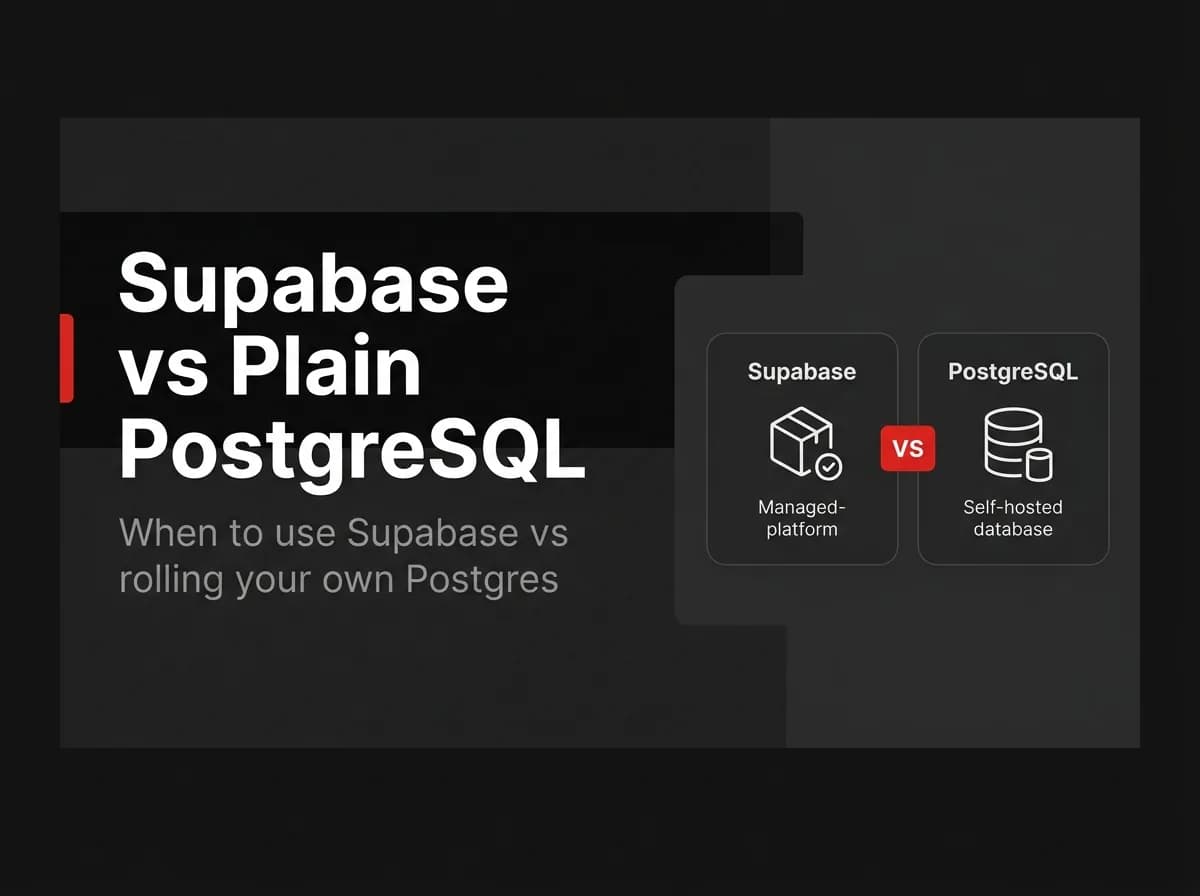
Supabase vs plain PostgreSQL is a question that confuses a lot of developers — because Supabase is PostgreSQL. The real comparison is "a bundled managed backend vs the database alone." Supabase adds authentication, storage, realtime, and auto-generated APIs on top of Postgres. Plain Postgres gives you the database and you build or own everything around it. Here's when to pick each.
Quick Answer
Supabase is PostgreSQL with a managed backend layered on top — auth, storage, realtime, and auto-generated APIs. Plain PostgreSQL is just the database; you add those layers yourself (or use a framework that already has them). Use Supabase to skip building a backend; use plain Postgres when you want full control over your own auth and application code. The data lives in Postgres either way.
The key point: Supabase is Postgres plus a backend
A common confusion: Supabase is not a different database from Postgres — it runs standard PostgreSQL. What Supabase adds is the backend around it. So "Supabase vs Postgres" is really "a bundled backend vs the database alone."
At a glance
Layer | Plain PostgreSQL | Supabase |
|---|---|---|
Database | Yes (you host it) | Yes (managed Postgres) |
Auth | You build/integrate | Built in |
Storage | You build/integrate | Built in |
Realtime | You build/integrate | Built in |
Auto APIs | No | Yes |
Control | Full | High, with Supabase conventions |
Best for | Own your stack | Skip backend building |
What Supabase adds
Supabase gives you authentication, file storage, realtime subscriptions, row-level-security patterns, and instant APIs over your tables. That is a real head start if you would otherwise build them.
What plain Postgres gives you
Plain Postgres gives you the full power of the database and complete control — you decide how auth, storage, and realtime work, using your own code or a framework. You own every layer and avoid vendor-specific conventions.
When to pick each
Pick Supabase if: you want a managed database plus a ready backend, fast.
Pick plain Postgres if: you want control over your own auth and app code, or your framework already provides those layers.
How this maps to FastStaq
FastStaq is a concrete example of "Postgres without the BaaS": it runs on plain PostgreSQL via Prisma and supplies its own auth (sessions, OAuth, magic link, RBAC), storage (S3/R2), and realtime (Socket.IO + Redis). So you get Supabase-style capabilities while owning the code and the database. And because it is just Postgres, you can host it on Supabase's managed Postgres if you want to. See Supabase alternatives, Neon vs Supabase, and the Supabase + Next.js guide.
Frequently asked questions
Is Supabase just Postgres? At its core, yes — Supabase runs standard PostgreSQL and adds a backend (auth, storage, realtime, APIs) around it.
Do I need Supabase or plain Postgres? Use Supabase to skip building a backend; use plain Postgres when you want full control or your framework already includes those layers.
Can I move from Supabase to plain Postgres? Your data and SQL are portable; you would replace the bundled backend features with your own.
Next steps
Compare Neon vs Supabase
Back to the Supabase + Next.js guide
Comparing SaaS boilerplates?
Get the SaaS Production Readiness Checklist, the 20 things any boilerplate has to get right before launch, plus a 6-part walkthrough of each one. One email to start, unsubscribe anytime.