SEO for Developers (2026 Guide)
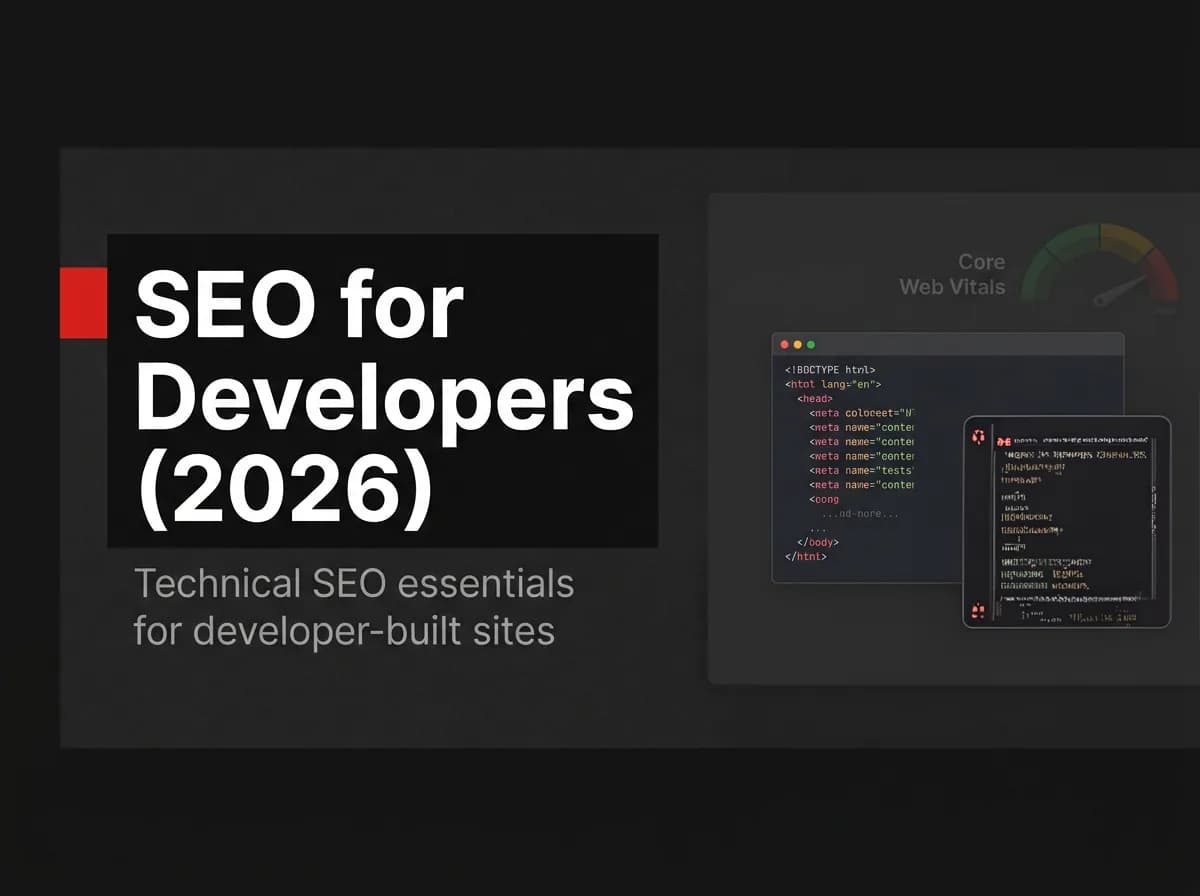
SEO for developers is mostly about things you control in code: making pages crawlable, shipping accurate metadata, hitting fast Core Web Vitals, adding JSON-LD, and server-rendering indexable content. Get those technical foundations right and your content has a real chance to rank — and be cited by AI answer engines. Here's the complete developer checklist for 2026.
Quick Answer
SEO for developers is mostly about the things you control in code: making pages crawlable (a correct sitemap and robots rules), shipping accurate metadata and canonical tags, hitting fast Core Web Vitals, using semantic HTML and structured data (JSON-LD), keeping URLs clean, and server-rendering content so crawlers see it. Get those technical foundations right and your content has a real chance to rank. The checklist below is the developer's share of SEO — the part you can fix in a pull request.
The developer SEO checklist
Ship a valid
sitemap.xmland sensiblerobots.txt.Set per-page
<title>and meta description, and a canonical URL.Hit Core Web Vitals (LCP, CLS, INP) with fast, stable pages.
Use semantic HTML and one clear
<h1>per page.Add structured data (JSON-LD) for articles, breadcrumbs, FAQs.
Keep URLs clean, stable, and lowercase; redirect changes (301).
Server-render or statically generate indexable content.
Set Open Graph/Twitter tags for link previews.
Crawlability: sitemap and robots
Search engines need to find and be allowed to index your pages. A generated sitemap.xml lists your URLs; robots.txt tells crawlers what to skip (admin, API, draft routes). Keep the two consistent — do not list a URL in the sitemap that robots blocks. See generate a sitemap in Next.js.
Metadata and canonical tags
Every indexable page needs a unique title and meta description and a self-referential canonical URL to avoid duplicate-content dilution. In a framework like Next.js this is per-route metadata.
// untested-here - illustrative only
export const metadata = {
  title: 'Your Page Title',
  description: 'A unique, accurate description under ~155 chars.',
  alternates: { canonical: 'https://example.com/your-page' },
};
Core Web Vitals and performance
Google measures real user experience: Largest Contentful Paint, Cumulative Layout Shift, and Interaction to Next Paint. Optimize images, avoid layout shifts, defer non-critical JS, and cache aggressively. Fast pages both rank better and convert better.
Semantic HTML and structured data
Use real headings and landmarks so crawlers understand structure, and add JSON-LD structured data so you qualify for rich results and answer-engine citations. Article, BreadcrumbList, and FAQPage are the high-value types for most SaaS content.
Rendering
Content that only appears after client-side JavaScript can be missed or delayed by crawlers. Server-render (SSR) or statically generate (SSG) the content you want indexed so it is in the initial HTML. See the full Next.js SEO checklist.
How this maps to FastStaq
FastStaq ships these technical foundations out of the box: an auto-generated sitemap.xml (client/app/sitemap.ts), a robots route, a blog RSS feed, per-page metadata and canonical tags, and JSON-LD builders (client/lib/seo/jsonLd.ts, including Article, BreadcrumbList, and now FAQPage). So the developer-SEO checklist above is largely handled, and you focus on content. See the Next.js SEO checklist.
Frequently asked questions
What part of SEO do developers own? The technical foundations: crawlability, metadata, canonical tags, performance, semantic HTML, structured data, and rendering.
Is technical SEO enough to rank? No — it is the foundation. You still need useful content that matches search intent, but weak technical SEO caps how well that content can perform.
Does FastStaq handle technical SEO? Yes — sitemap, robots, RSS, metadata, canonical, and JSON-LD ship built in.
Next steps
Follow the full Next.js SEO checklist
Set up your sitemap in Next.js
Explore the SaaS boilerplate guide