Next.js SEO - The Complete Checklist (2026)
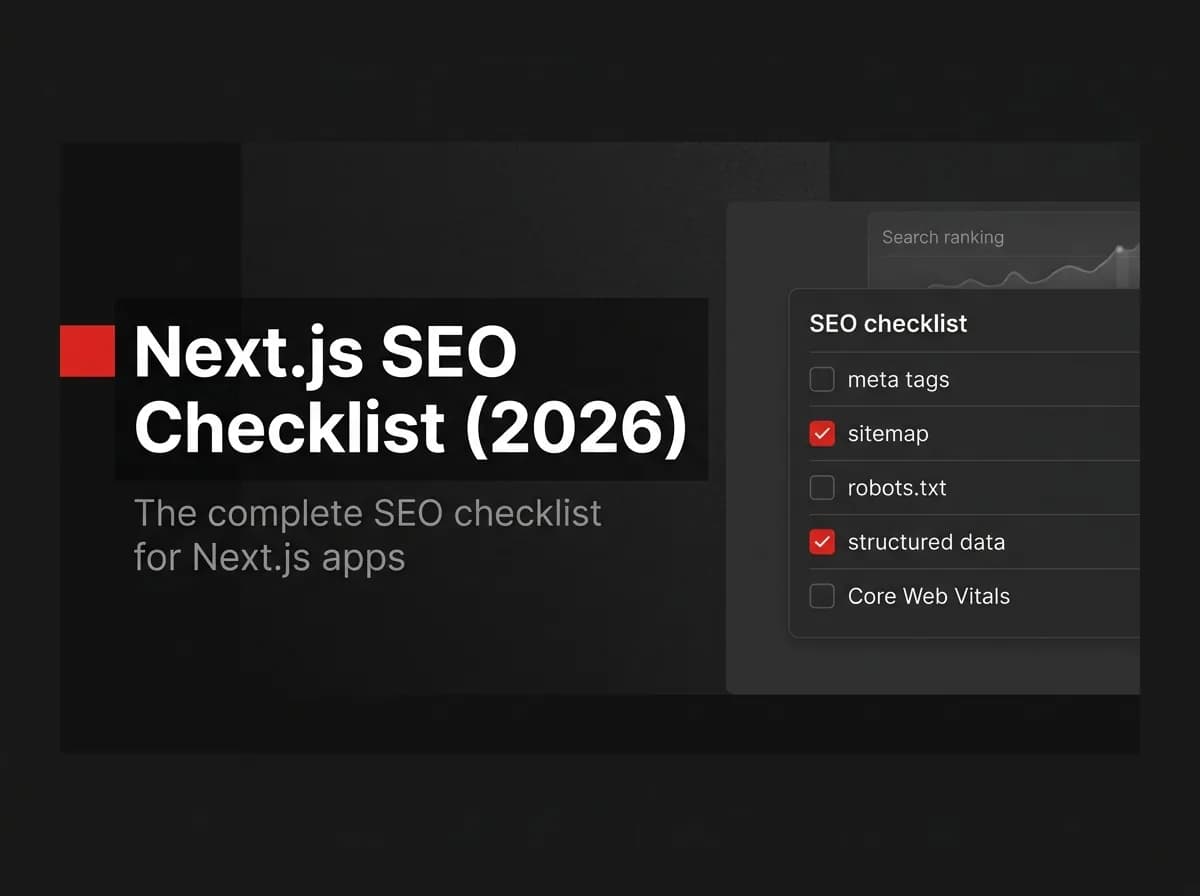
Next.js SEO comes down to five things: per-page metadata, a dynamic sitemap, JSON-LD structured data, fast Core Web Vitals, and correct canonical URLs. Do all five and you've covered both traditional search and AI answer engines. Here's the complete checklist — and what you can skip if your framework or CMS handles it for you.
Quick Answer
Next.js SEO comes down to five things: per-page metadata and Open Graph tags, a sitemap and robots file, structured data (JSON-LD) for rich results, fast Core Web Vitals, and correct canonical URLs. Generate the dynamic pieces — the sitemap and JSON-LD — from your content so they stay current as you publish.
Metadata and Open Graph
Give every page a unique title and meta description, plus Open Graph and Twitter tags for good link previews. In the App Router, export metadata per route so each page is distinct.
Sitemap and robots
Serve a sitemap so search engines discover every URL, and a robots file to allow crawling and point to the sitemap. Generate the sitemap from your content — see how to generate a sitemap in Next.js.
Structured data (JSON-LD)
Add JSON-LD for the content type — Article for posts, BreadcrumbList for navigation, FAQPage for Q&A. Rich results improve how your pages appear in search and feed AI answer engines.
{ "@context": "https://schema.org", "@type": "Article", "headline": "..." }Performance and Core Web Vitals
Fast pages rank and convert better. Optimize images, minimize client JavaScript, and lean on static rendering where possible — see Next.js caching.
Canonicals and RSS
Set canonical URLs to avoid duplicate-content dilution, and offer an RSS feed for content discovery and syndication.
The checklist
Unique title + meta description per page
Open Graph + Twitter tags
Sitemap generated from content
robots.txt pointing to the sitemap
JSON-LD for each content type
Canonical URLs set
Core Web Vitals in the green
RSS feed for the blog
How this maps to FastStaq
FastStaq ships built-in SEO: per-page metadata, a generated sitemap.ts, a robots file, JSON-LD (Article and BreadcrumbList), and RSS feeds. So most of this checklist is handled out of the box — you write content and the SEO scaffolding comes with it. See how to generate a sitemap in Next.js and the Supabase + Next.js guide.
Frequently asked questions
What is the most important Next.js SEO step? Unique, descriptive metadata per page plus a sitemap so everything is discoverable — then structured data.
Do I need JSON-LD? It is strongly recommended — it powers rich results and helps AI answer engines cite you accurately.
Does FastStaq handle SEO for me? It ships metadata, sitemap, robots, JSON-LD, and RSS built in; you still write good titles and content.
Next steps
Understand Next.js caching
Read the broader SEO for developers guide
Back to the Supabase + Next.js integration hub