Best SaaS Frameworks for Building Faster
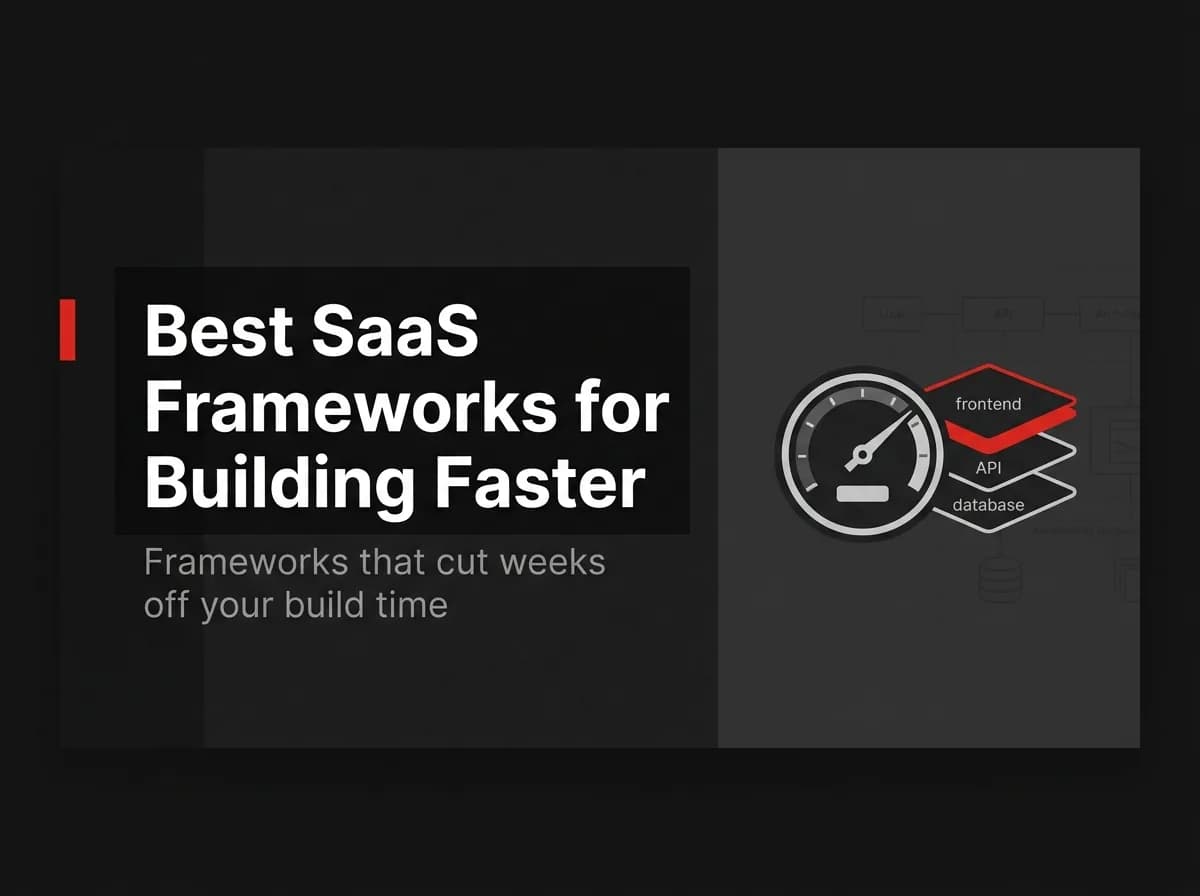
There's no single SaaS framework — that's the thing most founders realize only after they've tried to find one. What you actually need is a stack: a front-end framework, a backend, an ORM, a database, and the cross-cutting features (auth, billing, jobs) wired together. The fastest path to a production-ready SaaS framework stack is a boilerplate that does that wiring for you. Here's what the layers look like.
Quick Answer
There is no single "SaaS framework" — you assemble a stack: a front-end framework (Next.js), a backend (Express or Nest), an ORM and database (Prisma + PostgreSQL), plus auth, billing, and background jobs. The fastest path is to start from a boilerplate that wires these together, so you build features instead of plumbing.
Framework vs boilerplate
A framework (Next.js, Express) gives you structure for one layer. A boilerplate combines several frameworks plus the cross-cutting features every SaaS needs — auth, billing, jobs — into a working starting point. You still write your product on top.
Here's the thing: most SaaS teams spend their first sprint on this plumbing, not on their product. A boilerplate eliminates that sprint.
The front-end layer
Next.js is the common choice for SaaS front ends: routing, server rendering, and SEO support in one framework. It pairs with React for the UI.
The backend layer
Express (minimal) or Nest (structured) handle your API. The backend owns business logic, talks to the database, and processes background work.
The data layer
Prisma is a type-safe ORM over PostgreSQL — the relational default for SaaS. Migrations keep your schema versioned across environments (see Prisma migrations).
Typical SaaS stack
Layer | Common choice |
|---|---|
Front end | Next.js + React |
Backend | Express or Nest (TypeScript) |
ORM + database | Prisma + PostgreSQL |
Cache + jobs | Redis + a queue (BullMQ) |
Auth + billing | Your own auth + Stripe/Lemon Squeezy |
How this maps to FastStaq
FastStaq is not a framework — it is a boilerplate built on this exact stack: a Next.js client, an Express/TypeScript server, Prisma + PostgreSQL, and Redis/BullMQ, with auth and billing wired in. So it represents the "assemble the proven stack for you" option. Compare with the Next.js SaaS boilerplate and Node.js SaaS boilerplate guides.
Frequently asked questions
Is there one SaaS framework? No — you combine front-end, backend, and data frameworks; a boilerplate bundles them with auth and billing.
Next.js or a separate backend? Next.js can handle a lot, but most SaaS add a dedicated backend (Express/Nest) for jobs and complex logic.
What database should I default to? PostgreSQL — relational, transactional, and flexible enough for most SaaS data.
Next steps
Read the Next.js SaaS boilerplate guide
See the Node.js SaaS boilerplate guide
Read the best tech stack for a SaaS
Back to the SaaS boilerplate guide