The Best Tech Stack for a SaaS (2026)
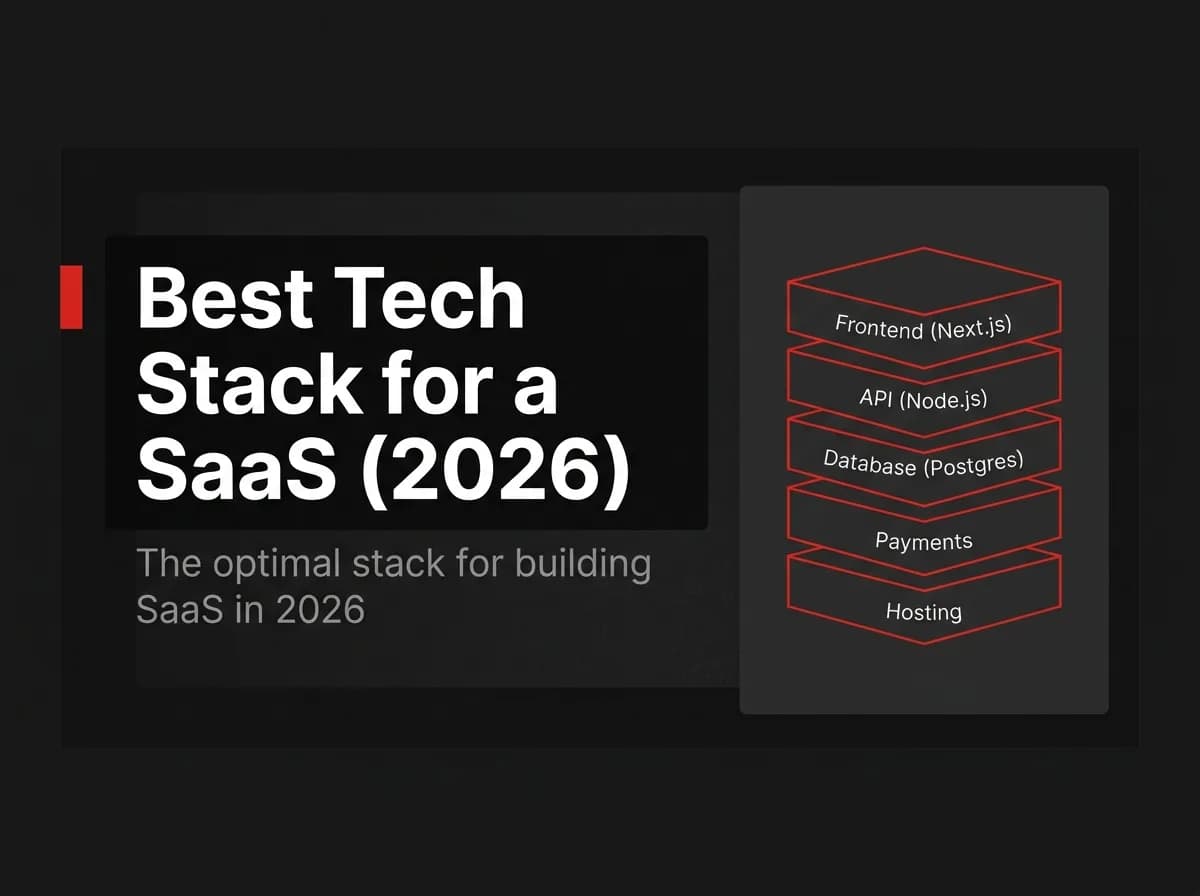
The best tech stack for a SaaS is not the flashiest one - it is the one your team can ship and maintain. That said, "boring and mature" maps to the same few choices for most SaaS products in 2026: Next.js on the front end, a typed Node API, PostgreSQL with Prisma, Redis for caching and queues, S3-compatible storage, and Stripe for payments. Here's the layer-by-layer breakdown.
Quick Answer
The best tech stack for SaaS in 2026 pairs a React framework (Next.js) on the frontend with a typed Node API (Express or Fastify), PostgreSQL for the database, Redis for caching and background jobs, S3-compatible storage for files, and Stripe for payments. This is not the only stack that ships production software, but it has the deepest hiring pool, the most mature tooling, and the fewest operational surprises for a small team. Swap in Remix, Fastify, or Drizzle where your team has a real reason to, not because a blog post told you to.
A tech stack is the set of frameworks, languages, and infrastructure choices you commit to for a product. For a SaaS specifically, that decision touches onboarding speed, your monthly cloud bill, and how easy it is to hire your third engineer.
You are not choosing a stack for a weekend project. You are choosing the thing you will debug on a Saturday morning eighteen months from now, so boring and well-documented beats new and exciting almost every time.
The SaaS stack, layer by layer
Here is the layer-by-layer breakdown, with the tradeoffs spelled out below the table.
Layer | Recommended | Why | Solid alternatives |
|---|---|---|---|
Frontend | Next.js (React) | Largest hiring pool, server rendering and static generation built in, huge component ecosystem | Remix, SvelteKit |
Backend / API | Node.js + Express or Fastify (TypeScript) | One language across the stack, typed request and response contracts, fast to hire for | NestJS, Go, Django |
Database | PostgreSQL | Relational integrity, native JSONB for flexible fields, runs on every major cloud | MySQL, SQLite for very small apps |
ORM | Prisma | Type-safe queries, migrations included, large ecosystem of docs and examples | Drizzle, Kysely |
Cache / Queue | Redis + BullMQ | In-memory speed for cache and sessions, a durable job queue for emails and webhooks | RabbitMQ, Amazon SQS |
File storage | S3-compatible (AWS S3, Cloudflare R2) | Cheap, durable, and portable since most providers speak the same S3 API | Google Cloud Storage |
Payments | Stripe | Deepest documentation, widest integration support, handles subscriptions and one-time sales | Lemon Squeezy, Paddle |
Auth | In-house system or a dedicated provider | Sessions, OAuth, 2FA, and role-based access all need to live somewhere | Auth.js, Clerk, Auth0 |
Deployment | Docker image on a managed host | Reproducible builds you can move between providers without a rewrite | Vercel, Railway, Fly.io |
Note: Vendor names in this table (Clerk, Auth0, Lemon Squeezy, Paddle, and others) are described at a general level only. Pricing and feature tiers change often; details checked July 2026, confirm current terms directly on each vendor's site before you commit.
Frontend: pick a React framework with a real ecosystem
For most SaaS products, Next.js is the right default. You get server-side rendering, static generation for marketing pages, and a component ecosystem (shadcn/ui, Tailwind, Radix) that covers most of what a dashboard needs without custom work.
Remix is a fair alternative if your team already prefers its data-loading model, and our Next.js vs. Remix comparison walks through the actual differences instead of the marketing pitch. SvelteKit is worth a look if you value a smaller bundle size and don't need the largest possible hiring pool.
I'd still reach for Next.js on a new SaaS in 2026. The hiring-pool argument alone tends to outweigh smaller technical wins once you have a team to grow.
State management deserves one line: Zustand or a similarly lightweight store beats a heavy Redux setup for most SaaS dashboards. You are managing a handful of UI slices, not a trading floor.
Backend and API: typed, boring, and easy to hire for
A SaaS backend has to do a few things well: handle auth, talk to the database, process webhooks, and stay easy to reason about as the codebase grows. TypeScript with Express or Fastify gets you there without asking your team to learn a second language.
Express is the safer default if you want the widest range of examples and middleware. Fastify is worth it if you have measured a real performance need, not a hypothetical one. NestJS adds structure and dependency injection if your team is coming from an enterprise Java or C# background and wants that shape.
A dedicated API server, separate from your frontend framework's built-in routes, also pays off the moment you add a mobile app, a public API, or a third-party integration. Next.js API routes work fine for a prototype; a standalone Express or Fastify service scales better once more than one client needs to talk to it. Our guide to picking a SaaS framework covers that decision in more detail.
tRPC is a reasonable choice if your frontend and backend live in the same monorepo and you want end-to-end type safety without writing REST contracts by hand. It is a worse fit the moment a mobile app or partner integration needs the same API.
Database and ORM: PostgreSQL is the default for a reason
PostgreSQL is the right database for almost every SaaS. It gives you relational integrity for billing and permissions data, native JSONB when you need flexible fields, and support across every major cloud and managed Postgres provider.
MongoDB can work if your data genuinely does not fit a relational model, but most SaaS data (users, workspaces, subscriptions, roles) is relational whether you model it that way or not. Forcing that data into documents usually costs more in application-level joins than it saves in flexibility.
For the ORM layer, Prisma remains the most widely adopted choice: type-safe queries, generated migrations, and a large body of documentation and community examples. Drizzle is a lighter, closer-to-SQL alternative that has picked up real adoption if your team wants more control over the generated queries.
Pro tip: Whichever ORM you pick, commit your migrations to version control from day one. Retrofitting a migration history onto a production database you have been editing by hand is a rough way to spend a weekend.
Our database comparison for SaaS goes deeper on Postgres vs. MongoDB vs. MySQL if you want the full breakdown.
Cache, queues, and file storage: the parts people forget
Redis does two jobs in most SaaS stacks: it caches expensive queries and session data, and it backs a job queue like BullMQ for anything that should not block an HTTP request. Sending a welcome email, processing a webhook, or generating a report are all queue jobs, not inline function calls.
Skip the queue at your own risk. Without one, a slow third-party API (email provider, payment webhook, whatever) turns into a slow, flaky request for your user instead of a background job that retries on its own.
For file storage, an S3-compatible bucket (AWS S3 or Cloudflare R2) is the standard choice. R2 is worth a look specifically because it does not charge for egress, which matters once you are serving user-uploaded files or generated reports at any real volume. Either way, validate file type and size on upload; an open file input is a fast way to end up storing something you did not intend to host.
Payments and auth: build vs. buy
Stripe is the default payments provider for a reason: the documentation is thorough, it supports subscriptions and one-time purchases in the same account, and most engineers have already integrated it once. Lemon Squeezy and Paddle are worth considering if you want a merchant-of-record model that handles international tax for you, at the cost of a larger cut of revenue.
Auth is the build-vs-buy decision most teams get wrong in one direction or the other. Rolling your own session handling, OAuth, and two-factor auth from scratch takes real time away from your actual product. Providers like Auth.js, Clerk, and Auth0 remove that work, at the cost of a recurring bill and, in some cases, per-user pricing that scales awkwardly as you grow.
Remember: Whatever you pick, you still need role-based access control the moment you have more than one type of user in a workspace. Bolting on permissions after launch is harder than building them in from the start.
How this stack maps to FastStaq
We built FastStaq around the exact stack recommended above, because we wanted to ship on it ourselves, not because it tests well in a table. Here is what that looks like in the source code:
Frontend: Next.js 16, React, Zustand for state, Tailwind and shadcn/ui for components.
Backend: a dedicated Express and TypeScript REST API, not Next.js API routes or tRPC.
Database: PostgreSQL through Prisma, with 76 data models and migrations already written.
Cache and queues: Redis with BullMQ workers handling emails, webhooks, and scheduled jobs.
File storage: S3-compatible, with Cloudflare R2 supported and upload validation built in.
Payments: Stripe by default, with a
PAYMENT_PROVIDERtoggle to switch to Lemon Squeezy, plus idempotent webhook handling with an event ledger so a retried webhook does not double-charge anyone.Auth: our own system, not a third-party auth provider: email/password sessions, Google OAuth, magic links, TOTP 2FA, trusted devices, API keys, and RBAC with an OWNER role at the top.
Deployment: Dockerized, with a production server image and 120+ passing tests plus CI checks.
FastStaq is $299 one time for lifetime access to the source code, not a subscription. It is marketed as 350+ hours of pre-built work, which tracks with everything listed above once you count auth, billing, the support desk, and the admin panel.
FAQ
What is the best tech stack for a SaaS? The best tech stack for SaaS in 2026 is Next.js on the frontend, a typed Node API (Express or Fastify), PostgreSQL with Prisma or Drizzle, Redis with a job queue like BullMQ, S3-compatible storage, and Stripe for payments. It is not the only stack that works, but it has the widest hiring pool and the most mature documentation for each piece.
Should I build my own auth or use a provider like Clerk or Auth0? Build your own if auth is core to your product's differentiation or you want full control over sessions, roles, and pricing. Use a provider if you would rather pay a recurring fee to skip that work entirely; check current pricing directly with the vendor, since tiers and per-user costs change.
Is PostgreSQL better than MongoDB for a SaaS? For most SaaS products, yes. SaaS data such as users, workspaces, subscriptions, and permissions is relational by nature, and PostgreSQL's JSONB support already covers the flexible-schema cases that used to push teams toward MongoDB.
Do I need microservices to launch a SaaS MVP? No. A single, well-structured API service with a background job queue handles the vast majority of SaaS workloads at MVP and early-growth stage. Split services out later if a specific part of the system genuinely needs independent scaling, not on day one.
Is a SaaS boilerplate worth it instead of building the stack from scratch? It depends on how much of this list you would otherwise build yourself. A boilerplate is worth it if it covers auth, billing, and the operational pieces like queues, webhooks, and storage that you would spend weeks on anyway; it is not worth it if you need a stack it does not support.
Where to go next
The stack that wins for most SaaS teams in 2026 is not exotic: Next.js, a typed Node API, PostgreSQL with Prisma or Drizzle, Redis and a queue, S3-compatible storage, and Stripe. Pick it, write it down, and stop re-litigating the decision every sprint.
If you want that stack wired up on day one instead of assembled piece by piece, take a look at the FastStaq boilerplate: $299 one time, lifetime access, full source code, and the auth, billing, and background job setup already done.