Makerkit vs ShipFast vs FastStaq (2026)
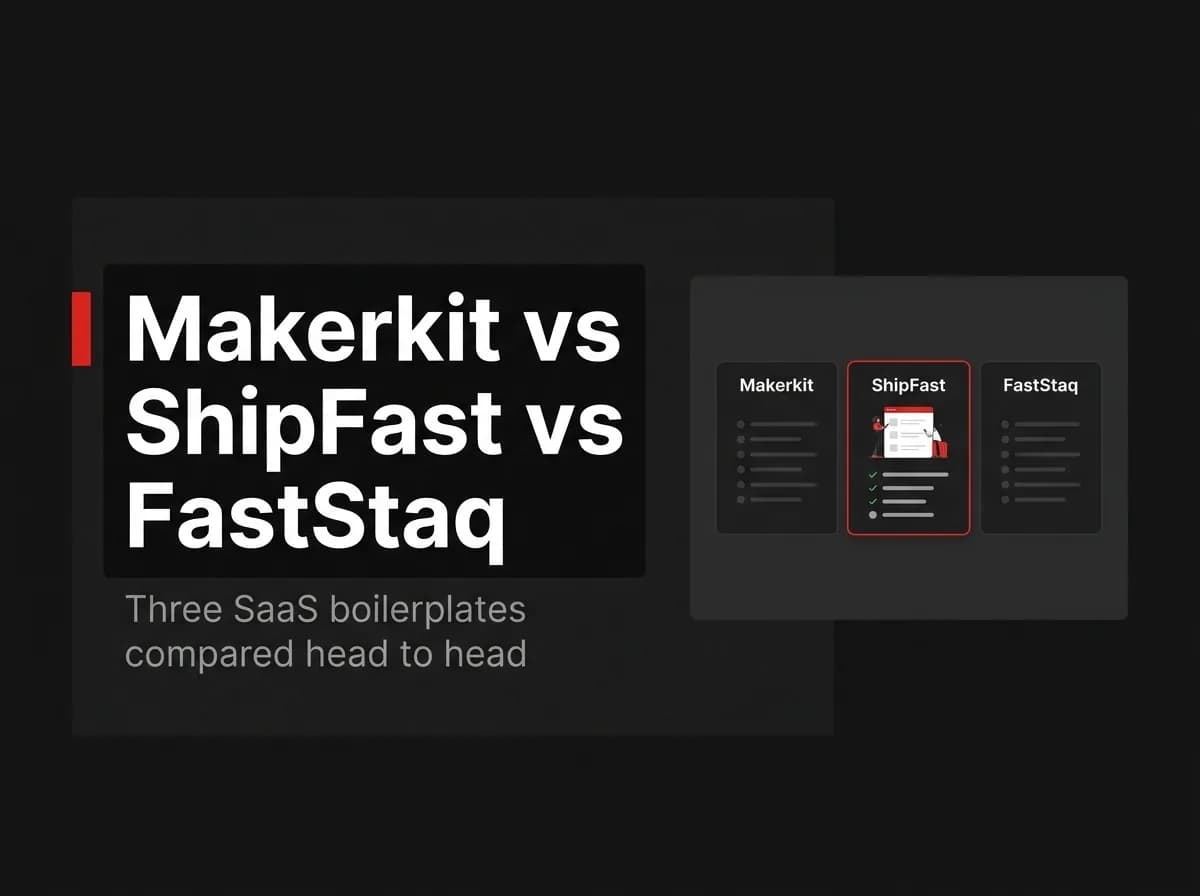
You're weighing Makerkit vs ShipFast because you don't want to rebuild auth, billing, and infrastructure again. A SaaS boilerplate is a pre-built codebase, usually covering exactly those two plus core infrastructure, that you buy once and customize instead of starting from zero. (Our SaaS boilerplate guide covers what a complete one should include.)
Here's the short version. ShipFast is the fastest route to a minimal MVP: one Next.js boilerplate, one-time purchase, small feature surface. Makerkit gives you more kit variants and heavier documentation, aimed at teams who want structure over speed. FastStaq is built for founders who want more of the SaaS pre-wired than either one covers, support desk, affiliate program, multi-tenancy, and compliance tooling included, for a single $299 payment with full source access.
Full disclosure: I work on FastStaq. Weigh that against your own research on the other two.
Makerkit vs ShipFast vs FastStaq at a glance
Note: Makerkit and ShipFast details below reflect what's publicly documented as of August 2026. Both vendors change pricing and scope on their own schedule, verify current tiers directly on their sites before you buy. This page is refreshed quarterly.
Dimension | ShipFast | Makerkit | FastStaq |
|---|---|---|---|
Pricing model | One-time purchase; tiers vary, verify on site | License-based, multiple tiers; verify on site | $299 one-time, lifetime access, no per-seat fees |
Source code access | Included | Included | Full source, self-serve GitHub repo access |
Stack | Next.js-based; specifics vary by tier, verify on site | Multiple kit variants across stacks; verify current lineup | pnpm monorepo: Next.js 16 client, Express + TypeScript API, shared package |
Database/ORM | Not published here; verify on site | Not published here; verify on site | PostgreSQL via Prisma, 76 data models, migrations included |
Auth | Built-in; verify current providers/features | Built-in; verify current providers/features | FastStaq's own system: email/password, Google OAuth, magic links, TOTP 2FA, API keys, RBAC |
Payments | Stripe is commonly cited; verify current integrations | Stripe is commonly cited; verify current integrations | Stripe by default, Lemon Squeezy via |
Modules beyond auth/billing | Lean, MVP-focused; verify current scope | Broader scaffolding: testing, docs, admin; verify current scope | Support desk, blog CMS, waitlist, affiliate program, multi-tenancy, outbound webhooks, compliance tooling |
Best for | Solo builders shipping the smallest possible MVP | Teams that want kit variety and heavier documentation | Founders who need more than auth and billing pre-wired |
Makerkit
Makerkit built its business around being a family of starter kits rather than one fixed boilerplate. Instead of a single codebase, it offers multiple kit variants across different stacks, with the pitch centered on structure: more built-in testing, more documentation, a codebase meant to hold up as a team grows past one founder.
That structure has a cost. More kit variants means more upfront decisions, which kit, which stack, which license tier, before you write your first feature. If you're comparing makerkit vs shipfast purely on setup speed, Makerkit is usually the heavier lift. If you want more standalone options in this category, see our Makerkit alternatives roundup.
Pricing and exact feature scope move independently of this page. Verify current tiers on Makerkit's site before you commit.
ShipFast
ShipFast takes the opposite approach: one boilerplate, aimed at solo builders who want to ship an MVP in days rather than a quarter. The scope is deliberately narrow, auth, payments, and SEO basics, without the multi-tenancy or admin scaffolding a bigger product eventually needs.
That narrowness is deliberate, and it's the reason ShipFast works well for early validation. If you're still testing an idea and don't know whether you'll need workspaces or a support desk, a smaller surface area means less to rip out later. For a wider set of options in this category, see our ShipFast alternatives roundup.
Current pricing and exact feature scope: verify on ShipFast's site, independent of this page's quarterly refresh.
Where FastStaq fits
Both ShipFast and Makerkit solve auth and billing. Past that, you're back to building: a support desk, an affiliate program, multi-tenant workspaces, webhook infrastructure, compliance tooling. Most SaaS products need at least a few of those within the first year. FastStaq bills itself as "350+ hours of pre-built work," and the module list backs that up.
Under the hood it's a pnpm monorepo: a Next.js 16 client (React, Zustand, Tailwind, shadcn/ui), an Express + TypeScript API server, and a shared package between them. Auth is FastStaq's own system, not a wrapper around a third-party provider, with email/password sessions, Google OAuth, magic links, TOTP 2FA, trusted devices, API keys, and role-based access control up to an OWNER role.
Billing runs through a pluggable gateway: Stripe by default, Lemon Squeezy through a PAYMENT_PROVIDER environment variable. Webhooks are idempotent with event ledgers, so a retried Stripe event doesn't double-charge or double-fulfill an order. A credits and usage-metering module ships in source if you're pricing on usage instead of seats.
The database is PostgreSQL through Prisma: 76 models, migrations included. That works with Supabase's or Neon's managed Postgres if you'd rather not run your own instance, you're not locked into a specific host.
Past core plumbing, FastStaq includes a support desk with live chat over socket.io and Redis pub/sub, a blog CMS, a waitlist, and an affiliate program with click attribution and payouts. Privacy tooling covers consent and data export/deletion. It's Dockerized with a production server image, and ships 120+ passing tests plus CI checks, so you're not the first person to hit the edge cases.
All of it is $299, one time, for lifetime access to the source. No per-seat pricing, no subscription to keep the license active.
How to choose
Pick ShipFast if you're validating a new idea solo, want the smallest boilerplate that gets you to launch, and don't yet know which of the bigger modules you'll need.
Pick Makerkit if you want a more structured starting point with heavier documentation and don't mind a license model built around ongoing kit updates.
Pick FastStaq if you already know your SaaS needs more than auth and billing, workspaces, a support desk, an affiliate program, compliance tooling, and you'd rather pay once for a wider base than assemble those pieces separately.
Pro tip: List the modules your SaaS needs in the first six months, not the ones you might need eventually. That list should decide between these three, not the marketing page.
None of these three wins on every dimension. The right pick depends on how much of the SaaS you want pre-built versus how much control you want over building it yourself.
FAQ
Is ShipFast or Makerkit better for a solo founder? For a solo founder shipping fast, ShipFast's narrower scope is usually easier to work with because there's less to configure before you start on features. Makerkit's kit variants and heavier documentation suit teams that want more structure from day one. Check current pricing and feature scope on both sites before deciding.
What does FastStaq include that Makerkit and ShipFast don't? FastStaq ships modules most boilerplates leave out: a support desk with live chat, an affiliate program with payouts, multi-tenant workspaces, an outbound webhooks platform, and compliance tooling for consent and data deletion. It also includes 76 Prisma data models and 120+ passing tests out of the box. Whether you need all of that depends on how far along your SaaS idea is.
Is FastStaq a subscription? No. FastStaq is a one-time $299 payment for lifetime access to the full source code, with no per-seat fees.
Can I use FastStaq with Supabase? Yes. FastStaq uses PostgreSQL through Prisma, so you can point it at Supabase's managed Postgres, or Neon's, by setting DATABASE_URL. FastStaq runs its own auth system rather than Supabase Auth.
Does FastStaq use Stripe or another payment provider? Stripe is the default, wired up with idempotent webhook handling and event ledgers to avoid duplicate processing. Lemon Squeezy is available as an alternative through the PAYMENT_PROVIDER environment toggle.
Remember: The FastStaq claims in this article come from the product's own docs and source, not marketing copy. Verify anything time-sensitive, current pricing, current module list, directly before you buy.
Where to go next
Makerkit vs ShipFast comes down to how much scope you want on day one: ShipFast for the smallest possible boilerplate, Makerkit if you want more structure and don't mind a heavier setup. If neither covers what your SaaS needs past auth and billing, that's the gap FastStaq is built to fill, with a support desk, affiliate program, and compliance tooling already wired up.
Check current pricing on FastStaq before you decide, and compare the module list against what you'd otherwise have to build.
Comparing SaaS boilerplates?
Get the SaaS Production Readiness Checklist, the 20 things any boilerplate has to get right before launch, plus a 6-part walkthrough of each one. One email to start, unsubscribe anytime.