How to Start a SaaS - A Step-by-Step Guide
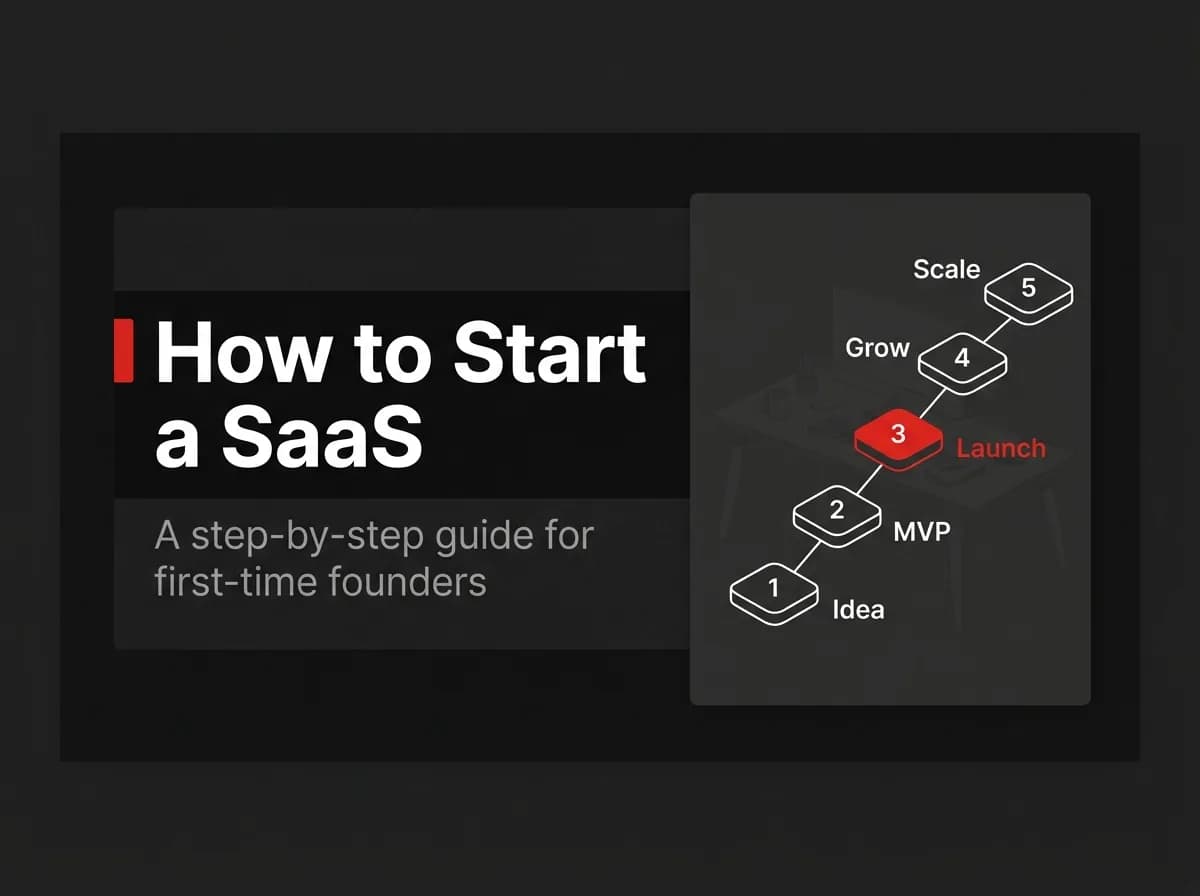
You start a SaaS by validating a specific problem with real users, defining the smallest MVP that solves it, building the product (faster if you start from a boilerplate instead of from scratch), launching to an audience that already has the problem, and iterating based on feedback and usage data. Skipping validation is the most common way founders waste six months.
Starting a SaaS means going from an unvalidated idea to a launched, paying product, in that order, not the reverse.
Step 1: Find and validate an idea before you write code
Most failed SaaS products aren't failed because of bad code. They're failed because nobody confirmed a paying audience existed before building.
Start with a problem you understand firsthand, ideally one from your own work or a domain you've operated in. You'll spot the edge cases faster and know which features are cosmetic versus which ones people actually need.
Validation looks like this:
Interview 10 to 15 people who currently deal with the problem. Ask what they use today, not what they'd want in a dream tool.
Look for an existing workaround. A spreadsheet, a manual process, or a competitor they're unhappy with is a stronger signal than enthusiasm alone.
Ask about budget directly. "Would you pay $X/month for this?" gets you a weaker answer than "What are you paying for [workaround] right now?"
Watch for repetition. If five different people describe the same pain point unprompted, that's the signal. If you're hearing five different problems, you haven't found the idea yet.
Note: A landing page with a waitlist form is not validation on its own. It measures curiosity, not willingness to pay. Pair it with actual conversations.
Step 2: Define the MVP
Once the problem is validated, resist the urge to build everything you imagined. The MVP is the smallest version of the product that solves the one core workflow you validated in Step 1, and nothing else.
A practical way to scope it: write down every feature you're tempted to include, then cross out anything that isn't required for a user to complete the core task end to end. Billing, admin dashboards, and team permissions are almost always version-two features, not version-one.
Define three things before you touch a keyboard:
The single user journey the MVP must support, start to finish.
What "done" looks like for that journey (a specific action the user completes).
What you're explicitly leaving out, and why.
In an early MVP, I cut the affiliate system because it had no effect on the core user journey. Users needed to sign up, use the product, and pay; referral tracking and commission payouts could wait. We shipped without it, and there was no clear impact on adoption or customer feedback. The cut saved development time without weakening the product users were actually evaluating.
Step 3: Build it (or start from a boilerplate)
This is where most of the calendar time goes if you build from zero. Auth, billing, background jobs, transactional email, and basic admin tooling are not the interesting part of your product, but they're required before a single paying customer can use it.
You have two paths here, and they trade off differently:
Build from scratch. You get full control over every architectural decision and no code you don't understand. The cost is time: wiring up authentication, a payment provider with idempotent webhook handling, file storage, and a queue system correctly takes real engineering effort, and it's easy to underestimate.
Start from a boilerplate. You skip the infrastructure work that's identical across most SaaS products and start building your actual feature set on day one. The tradeoff is less flexibility in the underlying architecture and a codebase you didn't write yourself, which means a ramp-up period to understand it.
I'd lean toward a boilerplate if your differentiation is in the product logic, not the infrastructure. Skip it if your core product is infrastructure (a new auth provider, for instance) and you need to own that layer completely.
Full disclosure: we build FastStaq, so weigh that against the general advice above. What it's for: a Next.js and Express monorepo with Postgres and Prisma (76 data models with migrations included), auth already wired (email/password, Google OAuth, magic links, TOTP 2FA, API keys, and role-based permissions), Stripe billing by default with idempotent webhook handling, and a support desk, blog CMS, and admin panel already built. It's a one-time $299 purchase for the full source, not a subscription. That compresses the infrastructure step in Step 3 specifically. It doesn't replace validation in Step 1 or scoping in Step 2, and it won't build your actual feature set for you.
Pro tip: Whichever path you choose, get a payment flow working end to end (checkout through webhook through database update) before you build anything else customer-facing. It's the piece most likely to have a subtle bug, and you want it caught early, not after your first real customer pays.
Step 4: Launch
Launch doesn't mean a single big-bang day. It means getting the product in front of the people you interviewed in Step 1, then widening from there.
A working launch checklist:
Product deployed to a production environment with a real domain
Analytics wired up (even basic pageview and signup tracking)
Payment flow tested end to end with a real test transaction
The people you interviewed during validation notified directly, before any public post
A public launch post (Product Hunt, X, a relevant subreddit, or a niche community, depending on where your audience actually spends time)
A way for early users to reach you directly (email, a chat widget, or a support inbox you actually check)
The direct outreach to your validation interviewees matters more than the public post. They already told you they had the problem. That's your warmest possible audience, and it costs nothing but a message.
Step 5: Get your first customers
Early customer acquisition for a new SaaS is manual, and that's normal. It doesn't scale, and it isn't supposed to yet.
What tends to work at this stage:
Direct outreach to people matching your validated user profile, referencing the specific problem you're solving for them.
Communities where your audience already gathers, contributing before you promote anything.
Content that answers a real question your target user searches for, tied to your product where it genuinely fits.
Asking every early customer for one referral, once they've gotten value, not before.
Track where each signup came from from day one. At 10 customers this feels unnecessary. At 50, it's the only way to know which channel to double down on.
Step 6: Measure and iterate
Once you have real users, the product roadmap should come from what they do and say, not from your original assumptions.
Track three numbers from the start:
Activation rate: the percentage of signups who complete the core workflow you defined in Step 2.
Retention: whether users come back and keep using the product after the first session.
Churn reason: for every cancellation, ask why, even if it's a one-line email reply.
Low activation usually points to onboarding friction, not a bad product. Low retention after high activation usually points to a product that solves a one-time problem rather than a recurring one, which changes your pricing and marketing more than your code.
Iterate on the smallest change that could move the metric, ship it, and measure again before adding the next feature.
FAQ
How long does it take to build a SaaS? It depends heavily on scope and whether you're building the infrastructure layer from scratch. A narrow MVP built on top of existing infrastructure (your own prior code or a boilerplate) can often reach a working version in a few weeks. Building auth, billing, and background jobs from zero typically adds weeks to months before you're building your actual feature set.
Do I need to know how to code to start a SaaS? No, but you need either coding skills, a technical co-founder, or a developer you're paying. No-code tools can validate simple ideas, but most SaaS products with real data models, integrations, or billing logic eventually need custom code.
How much does it cost to start a SaaS? Costs vary by scope, but the largest cost for most solo founders is time, not money. Hosting, a domain, and basic tooling can run under $50/month to start. A one-time boilerplate purchase (FastStaq is $299 one-time, for example) is a smaller cost than the engineering hours it replaces.
Should I use a SaaS boilerplate? Use one if your product's value is in your specific feature set rather than in the underlying infrastructure, and you'd rather spend your first weeks on that feature set. Skip one if you need full control over the architecture or your product's core differentiation is the infrastructure itself.
What's the difference between an MVP and a full product? An MVP supports exactly one validated user journey end to end and nothing else. A full product adds the features that come after you've confirmed people will pay: team permissions, deeper integrations, an admin dashboard, and so on. Building the full product before validating the MVP is the most common way founders lose months.
Where to go next
Validate before you build, scope the MVP down to one workflow, and only then decide whether to build the infrastructure yourself or start from a foundation that's already wired up. The order matters more than any individual tool choice.
If you're deciding between building from scratch and starting from a boilerplate, see how to build a SaaS MVP for a closer look at scoping. If you're weighing this as a side project versus a full commitment, the indie hacker path to a micro SaaS covers that decision.