What Is B2B SaaS (Definition, Examples, and Metrics)
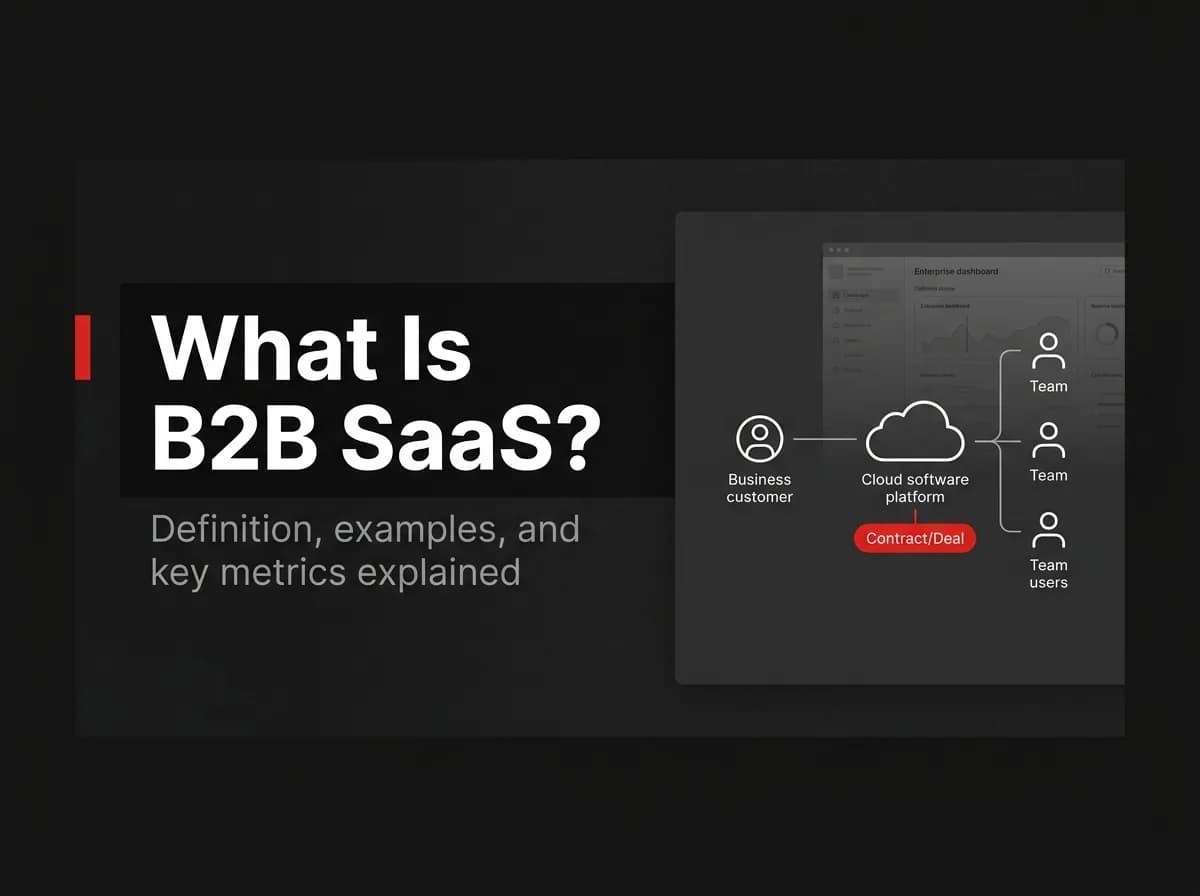
B2B SaaS (business-to-business software-as-a-service) is subscription software sold to companies rather than individual consumers. Customers pay a recurring fee to use software that the vendor hosts and maintains, common examples include CRMs, project management tools, and analytics platforms. B2B SaaS is known for higher contract values, longer sales cycles, and metrics like MRR, churn, CAC, and LTV that founders track closely.
What does B2B SaaS mean?
B2B SaaS is subscription software that businesses buy to use, hosted and maintained by the vendor. Instead of installing software on your own servers, your company logs into a web app, pays monthly or annually, and the provider handles updates and infrastructure.
The "SaaS" part means you're renting access, not buying a license outright. The "B2B" part means your customer is a company, or a team inside one, not an individual paying out of pocket for a personal app.
Note: FastStaq itself is a B2B SaaS boilerplate: a pre-built foundation (auth, billing, multi-tenancy, and more) that you'd otherwise spend months building before you could sell your own B2B SaaS product.
B2B SaaS vs B2C SaaS: what's different?
The core delivery model is the same across both: software hosted by a vendor, paid for on a recurring basis. What changes is who buys it, how they buy it, and what you optimize for.
In B2B SaaS, the buyer is often not the end user. A finance lead might sign off on a tool that an engineering team uses daily. Sales cycles run longer because multiple stakeholders (finance, IT, legal) approve a contract before it closes, and average deal sizes tend to be larger. Losing a single enterprise account can move revenue more than losing a batch of free-tier users ever would in B2C.
B2C SaaS sells to individuals who self-serve: they see a price, enter a card, and start using the product within minutes. Volume matters more than any single account, and price points stay low enough that one person can approve the purchase without asking anyone else.
Dimension | B2B SaaS | B2C SaaS |
|---|---|---|
Buyer | Company or team, often not the end user | Individual consumer |
Sales cycle | Weeks to months, multiple approvers | Minutes to days, self-serve |
Contract value | Higher per account | Lower per account, higher volume |
Onboarding | Often assisted (sales, support, or CS) | Self-serve |
Churn tolerance | Lower: losing one account hurts more | Higher: spread across many users |
Core metrics | MRR, ARR, CAC, LTV, NRR | MAU, DAU, conversion rate, LTV |
Examples of B2B SaaS by category
B2B SaaS spans nearly every business function. A few categories to ground the definition:
Customer relationship management (CRM): tools that track leads, deals, and customer communication across a sales team.
Project and work management: shared boards, tasks, and timelines for teams coordinating work.
Support and help desk: ticketing, live chat, and knowledge base software for customer support teams.
Analytics and business intelligence: dashboards that turn product or business data into reports.
DevOps and infrastructure: monitoring, CI/CD, and deployment tooling built for engineering teams.
HR and payroll: onboarding, benefits, and payroll processing sold to companies, not employees directly.
Marketing automation: email sequences, lead scoring, and campaign tooling for marketing teams.
Some of these tools serve individuals too (a freelancer might use a project management tool solo), but they're built and priced for teams: seat-based pricing, admin roles, and shared workspaces are the tell.
Pro tip: If your product needs seats, roles, and a shared workspace before it's useful, you're building B2B SaaS, whether or not you set out to.
Key metrics for B2B SaaS
Four metrics show up in nearly every B2B SaaS conversation, whether you're pitching investors or deciding what to build next.
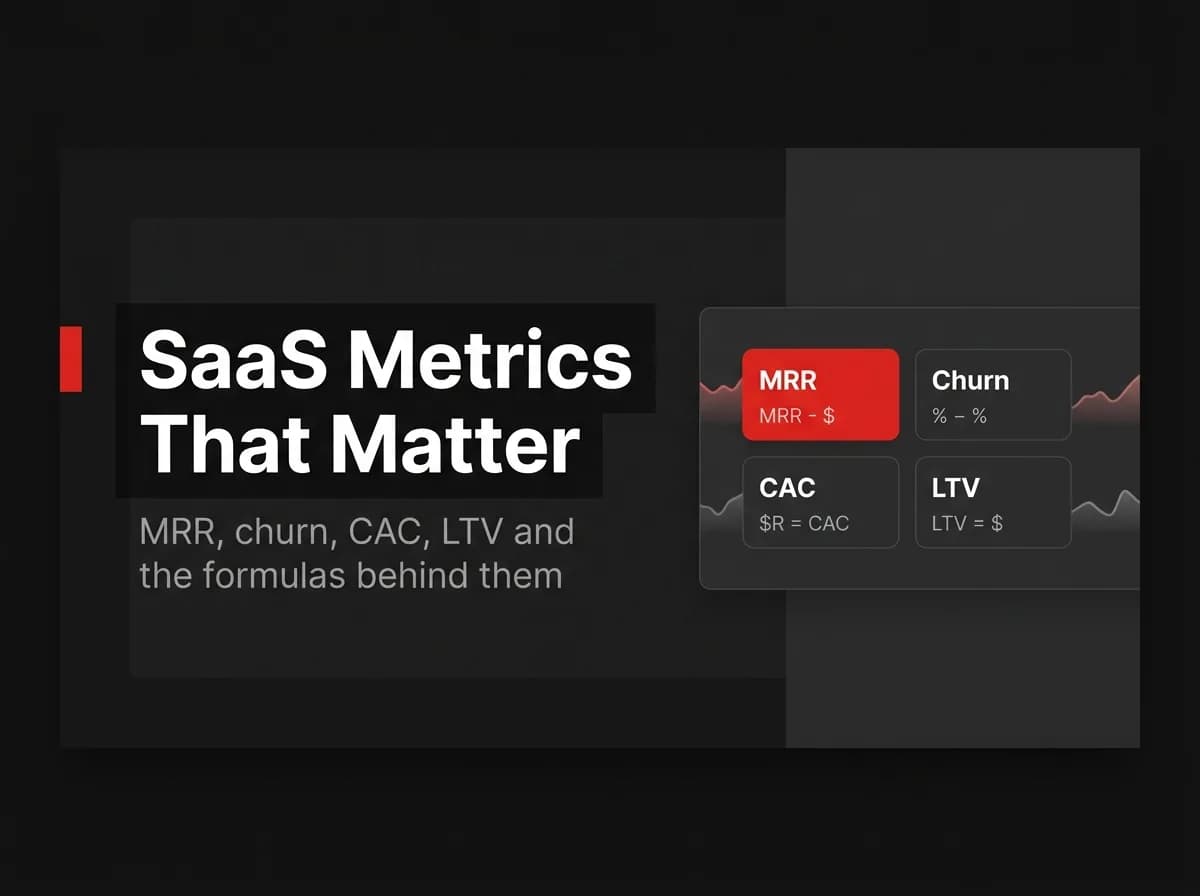
MRR (Monthly Recurring Revenue): the predictable revenue you can count on each month from active subscriptions. Add up every customer's monthly subscription value; one-time fees don't count.
Churn: the percentage of customers, or revenue, you lose in a given period. Customer churn counts accounts that cancel; revenue churn weighs those cancellations by how much they were paying, which matters more once you have a mix of small and large accounts.
CAC (Customer Acquisition Cost): what it costs, in sales and marketing spend, to land one paying customer. Divide total acquisition spend for a period by the number of new customers it produced.
LTV (Lifetime Value): the total revenue you expect from a customer over the life of the relationship. A common formula is average revenue per account divided by churn rate, though the exact model varies by business.
Remember: these four metrics interact. A high CAC is fine if LTV is high enough and churn is low; that same CAC can sink a business with high churn. Track them together, not in isolation.
Why founders build B2B SaaS
B2B SaaS attracts founders for a few concrete reasons.
Recurring, predictable revenue. A subscription model means you can forecast revenue months out, instead of hunting for the next one-off sale.
Higher willingness to pay. Businesses buy tools to save employee time or generate revenue, and they measure return on that basis, not on personal budget. That usually means higher price points than a consumer app selling similar core functionality.
Retention compounds. A business that's built a workflow inside your tool (onboarding, permissions, integrations) has switching costs that consumer apps rarely have. Lower voluntary churn means the LTV math above tends to work in your favor.
When we chose to focus FastStaq on B2B SaaS, the deciding factor was the type of problem we wanted the product to solve. Consumer apps can often launch with a single-user account and a simple checkout. A product sold to companies needs workspaces, invitations, permissions, billing controls, and support workflows much earlier.
That heavier foundation was also the opportunity. B2B customers pay for software that removes a measurable cost or improves a business process, so the product does not need consumer-scale traffic to become useful. A smaller number of customers can provide clearer feedback because they are using the software inside a real workflow.
The tradeoff was accepting more engineering before launch. We had to treat authentication, role-based access control, billing, and multi-tenancy as core product requirements rather than tasks for a later release. That decision shaped FastStaq into a boilerplate for founders facing the same B2B setup work.
Tradeoff: none of this is free. B2B buyers expect security basics, admin controls, and reliable support before they'll sign a contract. That's more upfront engineering than a simple consumer app needs: auth, roles, billing, and workspace management usually have to exist before you can charge a company real money.
How FastStaq helps you build B2B SaaS faster
Every B2B SaaS product needs roughly the same non-negotiable pieces before you can sign your first company. FastStaq ships those pieces pre-built, sold once for $299 with lifetime access instead of a recurring fee.
Auth and access control: FastStaq runs its own auth system, with email/password sessions, Google OAuth, passwordless email sign-in links, TOTP two-factor authentication, and trusted devices out of the box. Role-based access control (RBAC) is wired up too, with OWNER as the highest role, so you can gate features by role from day one.
Billing: Stripe is the default payment gateway, with Lemon Squeezy available through a PAYMENT_PROVIDER toggle. Checkout, a customer portal, subscriptions, one-time and lifetime purchases, and idempotent webhook handling with event ledgers for deduplication are all pre-built. A credits and usage-metering module ships in source if your pricing needs metered billing.
Multi-tenancy: B2B customers usually mean teams, not individuals. FastStaq includes workspaces, memberships, workspace-level roles, and invitations, so a company can add teammates without you building that structure from scratch.
Note: this maps directly to the essentials covered above: auth, RBAC, billing, and multi-tenancy are the four things nearly every B2B SaaS founder rebuilds before their first paying company signs up. FastStaq ships all four pre-built.
FAQ
What is B2B SaaS in simple terms? B2B SaaS is software that one business sells to another business on a subscription basis, hosted and maintained by the seller. The customer is a company, not an individual consumer, and payment recurs monthly or annually instead of being a one-time purchase.
How is B2B SaaS different from B2C SaaS? B2B SaaS sells to companies through longer sales cycles, multiple approvers, and higher contract values, while B2C SaaS sells to individuals who self-serve and pay smaller amounts. B2B products also lean on metrics like CAC and NRR, while B2C products track daily and monthly active users more closely.
What are some examples of B2B SaaS? Common examples include CRM platforms, project management tools, support and help desk software, analytics dashboards, DevOps tooling, HR and payroll systems, and marketing automation platforms. Software sold to a company for a team to use, priced by seat or workspace, generally counts.
What metrics matter most for B2B SaaS? MRR, churn, CAC, and LTV are the four metrics most B2B SaaS founders track first. Together they show whether the business generates predictable revenue at a cost that's sustainable given how long customers stick around.
Is B2B SaaS a good business model for a solo founder? It can be: recurring revenue and higher contract values are attractive for a small team. The tradeoff is that B2B buyers expect production-ready basics like auth, billing, and admin controls before they'll pay, which is exactly the gap a boilerplate like FastStaq is built to close.
Where to go next
B2B SaaS means subscription software sold to companies, built around recurring revenue, higher contract values, and metrics like MRR, churn, CAC, and LTV. It differs from B2C SaaS mainly in who buys it and how long that decision takes. The categories are broad (CRM, project management, analytics, DevOps, HR, marketing automation) but the shared shape is the same: a company pays recurring fees for software it doesn't have to build or host itself.
If you're deciding whether to build one, start by mapping which of the B2B essentials, auth, billing, RBAC, multi-tenancy, you'd have to build yourself versus buy pre-built.
If you want the production-ready foundation with auth, billing, and workspaces already wired up, FastStaq ships all of it for $299 one time, lifetime access, at faststaq.com.