Supabase vs Firebase - An Honest 2026 Comparison
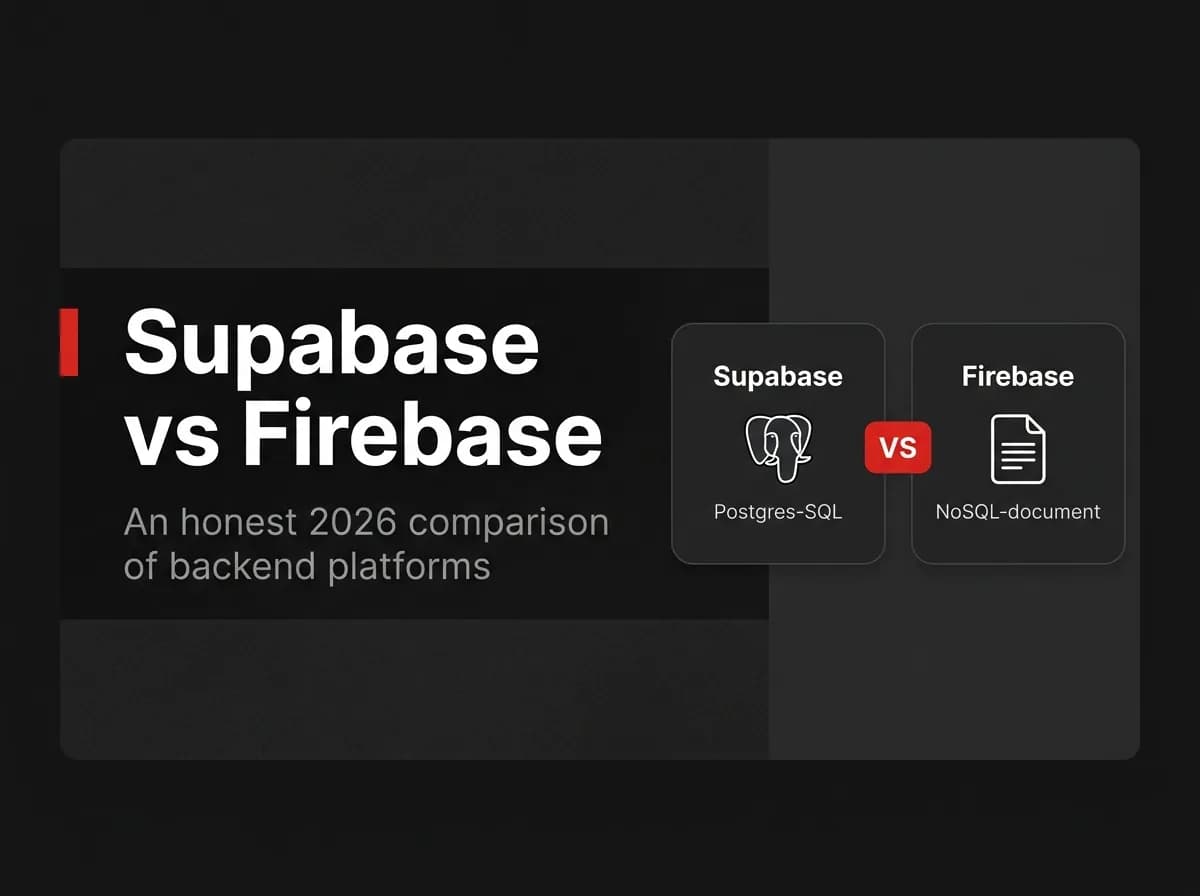
Choose Supabase if you want a relational PostgreSQL database, SQL, and row level security enforced directly in the database. Choose Firebase if you want a mature, fully managed NoSQL platform with deep Google Cloud integration and real-time document sync out of the box. In the Supabase vs Firebase decision, Supabase fits apps with relational data and a need for portability; Firebase fits apps that prioritize managed infrastructure and are comfortable inside Google's ecosystem.
Supabase is an open source backend platform built on PostgreSQL. Firebase is Google's proprietary backend platform built on the NoSQL document database Firestore.
You're picking a database, an auth system, and a realtime engine at the same time, because both platforms bundle all three. That bundling is the whole pitch, and it's also where the tradeoffs live.
What each platform actually is
Supabase wraps a dedicated Postgres instance with an Auth service, file Storage, Edge Functions, and a Realtime engine that listens to Postgres changes. The stack is open source, and you can self-host it if you'd rather run it yourself.
Firebase is Google's app development platform. Its default database is Firestore, a NoSQL document store, though it also offers the older Realtime Database. Auth, Hosting, Cloud Functions, and Cloud Messaging round out the platform, all billed through Google Cloud.
Neither one is just a database. Both are backend platforms that happen to include one.
Supabase vs Firebase: decision table
Note: Pricing and feature limits change often on both platforms. Figures below are current as of July 2026 and sourced from each vendor's official documentation; confirm current numbers at supabase.com/pricing and firebase.google.com/pricing before committing to either one.
Dimension | Supabase | Firebase |
|---|---|---|
Database type | Relational (PostgreSQL) | NoSQL document store (Firestore), plus a legacy Realtime Database |
Query language | SQL, with auto-generated REST and GraphQL APIs | Firestore's query API; no native joins, so relations are handled client-side or via denormalization |
Auth | Supabase Auth: email/password, OAuth, magic links, phone, TOTP MFA, SSO on paid tiers | Firebase Authentication: email/password, OAuth, phone, anonymous sign-in |
Realtime | Realtime engine streams Postgres row changes, plus broadcast and presence channels | Firestore's |
Storage | S3-compatible object storage, access controlled by Row Level Security | Cloud Storage for Firebase, backed by Google Cloud Storage |
Pricing model | Flat monthly base (Free, $25 Pro, $599 Team) plus metered overages on compute, egress, and storage | Free Spark tier, then Blaze pay-as-you-go billed per read, write, invocation, and GB |
Self-host | Yes, an official Docker Compose stack | No, Firebase is Google-hosted only |
Lock-in | Lower: Postgres and the open source stack port to any Postgres host | Higher: Firestore's data model and query API are Google-specific |
Data model: Postgres vs Firestore
Supabase's database is relational. Your data lives in tables, and you can join them in a single SQL query, which fits anything with structured relationships: users, subscriptions, invoices, permissions.
Firestore is a document database. Data lives in collections of JSON-like documents, and there's no native join. You either fetch related documents client-side or duplicate data across documents to avoid extra reads, which is a real design decision, not a shortcut.
Here's the same relationship modeled both ways. Untested, illustrative only:
sql
-- Supabase (Postgres): one query, one round trip
select orders.id, orders.total, customers.email
from orders
join customers on customers.id = orders.customer_id
where customers.email = 'jane@example.com';
js
// Firestore: fetch the customer, then fetch their orders separately
const customer = await db.collection('customers').doc(customerId).get();
const orders = await db.collection('orders')
  .where('customerId', '==', customerId)
  .get();
Row Level Security (RLS) is Supabase's answer to "who can see this row." Policies are written in SQL and enforced by Postgres itself, so the rule applies no matter how the request arrives: the REST API, a Realtime subscription, or a direct connection. Firestore's equivalent is Security Rules, a separate rules language that governs reads and writes per collection and document path.
Pro tip: if your data is inherently relational, joins in SQL beat assembling data from several document fetches. If your data looks like independent documents (chat messages, activity feeds, user profiles), Firestore's model gets out of your way faster.
Auth and realtime
Supabase Auth issues JSON Web Tokens that Row Level Security policies read directly, through helper functions like auth.uid(). The same login session that gets a user into your app also determines exactly which rows they can touch in the database, without a separate authorization layer.
Firebase Authentication covers the same login methods (email, OAuth, phone, anonymous), and it plugs into Firestore's Security Rules the same way, checking request.auth.uid inside a rule. The mechanism differs; the goal is identical.
Realtime is where both platforms genuinely compete. Supabase streams Postgres row changes to subscribed clients and adds presence and broadcast channels for cursors, typing indicators, and multiplayer state. Firestore's onSnapshot listeners do the same job for document changes, and the Realtime Database, Firebase's original product, was built for live sync from day one.
I'd give Firebase's realtime a slight edge for years of production hardening across mobile apps specifically. Supabase's realtime is younger but closing the gap fast, and it has the advantage of working against data you can also query with plain SQL.
I ran into this tradeoff while building FastStaq. The product started with familiar SaaS requirements such as users and accounts, but the schema quickly had to support workspaces, memberships, roles, subscriptions, invoices, affiliate payouts, support conversations, and audit records. Those features depend on relationships that need to stay consistent across the product.
That was where Postgres earned its place. I could connect billing records to workspaces, permissions to memberships, and support activity to the correct customer without duplicating the same data across several document collections. Realtime updates still mattered for features such as support chat and notifications, but I wanted those updates to sit on top of the same relational source of truth used by the rest of the application.
The experience changed how I evaluate backend platforms. Firestore listeners are attractive when the data is naturally document-shaped, but I now start by asking how many relationships the product will need after billing, permissions, and admin tooling arrive. For FastStaq, a Postgres foundation was the better fit because the relational complexity was part of the product, not an edge case.
Pricing and lock-in
Supabase's Free plan includes 500 MB of database storage, 50,000 monthly active users, and 200 concurrent realtime connections at no cost, though free projects pause after a week of inactivity. Pro starts at $25 a month and adds 100,000 MAUs, 8 GB of disk, and 250 GB of egress, with metered overages past those limits. Team moves to $599 a month for SOC 2, SSO, and longer backup retention.
Firebase's Spark plan needs no payment method and includes daily quotas like 50,000 Firestore reads and 20,000 writes a day, generous enough for early development. Blaze, the pay-as-you-go tier, keeps Spark's free quotas and then bills per read, write, function invocation, and gigabyte transferred, with $300 in free credit for eligible upgrades.
The two pricing models reward different usage patterns. Supabase's flat base plus overages is easier to forecast for a SaaS product with a roughly known user count. Firebase's per-operation billing rewards light, bursty usage and can climb fast with chatty read patterns, a common complaint among teams running heavy Firestore listeners at scale.
Lock-in is the part people underweight until they need to leave. Supabase's core is Postgres, so a migration means moving a Postgres database, something every cloud provider and most developers already know how to do. Firebase's migration path off Firestore means rebuilding your data model and rewriting your security rules from scratch, since no equivalent NoSQL target speaks the same query API.
For a closer look at one specific Postgres alternative, see our Neon vs Supabase comparison.
Which should you choose
Choose Supabase if your data is relational, you want SQL, you might self-host someday, or you want an easier exit if you switch providers later.
Choose Firebase if you're building a mobile-first app, you want the most battle-tested realtime sync available, or you're already committed to Google Cloud for the rest of your stack.
Skip the decision entirely if you're prototyping something disposable. Either platform's free tier gets a weekend project live, and you can revisit the choice once real usage tells you what you actually need. If Supabase fits but you want to weigh other Postgres-based options too, our Supabase alternatives roundup covers the field.
How this maps to FastStaq's stack
We built FastStaq on PostgreSQL through Prisma, with 76 data models covering auth, billing, and multi-tenancy out of the box. That's the Supabase side of this comparison: relational data, SQL, and a schema you can inspect and extend directly.
To be clear, FastStaq doesn't bundle Supabase or Firebase. It ships its own auth system (email/password sessions, Google OAuth, magic links, TOTP 2FA) wired directly to that Postgres schema through Prisma. Because the database connection is a single DATABASE_URL, you can point FastStaq at Supabase's managed Postgres, at Neon, or at any Postgres host, and keep FastStaq's own auth, billing, and RBAC running on top.
Full disclosure: FastStaq ships this way because relational data is what most SaaS billing and permissions logic needs. If your product's data is closer to Firestore's use case, a document-first backend and a boilerplate built around it will fit you better than FastStaq will.
FAQ
Supabase vs Firebase: which is better for a new SaaS product? Neither wins universally. Supabase tends to fit SaaS products better because subscriptions, invoices, and permissions are inherently relational, but Firebase works fine for SaaS products with lighter, document-shaped data.
Is Supabase better than Firebase? Supabase is the stronger fit when you need SQL, joins, or Row Level Security enforced at the database level. Firebase is the stronger fit when you need Google's most mature realtime and mobile SDKs.
Should I choose Firebase or Supabase for a startup? Both have usable free tiers for a startup's first version. Firebase's Spark plan needs no payment method, while Supabase's free tier gives more relational database headroom (500 MB, 50,000 MAUs) before you have to pick a paid plan.
Can I switch from Firebase to Supabase later? Yes, but it's a real migration, not a config change. You'll redesign your data model from Firestore documents into Postgres tables and rewrite your security rules as SQL policies, so treat it as a project rather than a weekend task.
Where to go next
Supabase and Firebase both bundle a database, auth, storage, and realtime into one platform, and the right pick comes down to your data model more than any single feature. Pick Supabase for relational data, SQL, and an easier exit path. Pick Firebase for mobile-first apps deep in Google's ecosystem. If you're still deciding, sketch your core data model on paper first: tables with relationships point to Supabase, independent documents point to Firebase.
If you already know you want Postgres and SQL, see how FastStaq wires Prisma and Postgres into a production-ready foundation, with 76 data models and its own auth system, so you're not assembling that piece from scratch.
Comparing SaaS boilerplates?
Get the SaaS Production Readiness Checklist, the 20 things any boilerplate has to get right before launch, plus a 6-part walkthrough of each one. One email to start, unsubscribe anytime.