Node.js SaaS Boilerplate - Express and Prisma Stack
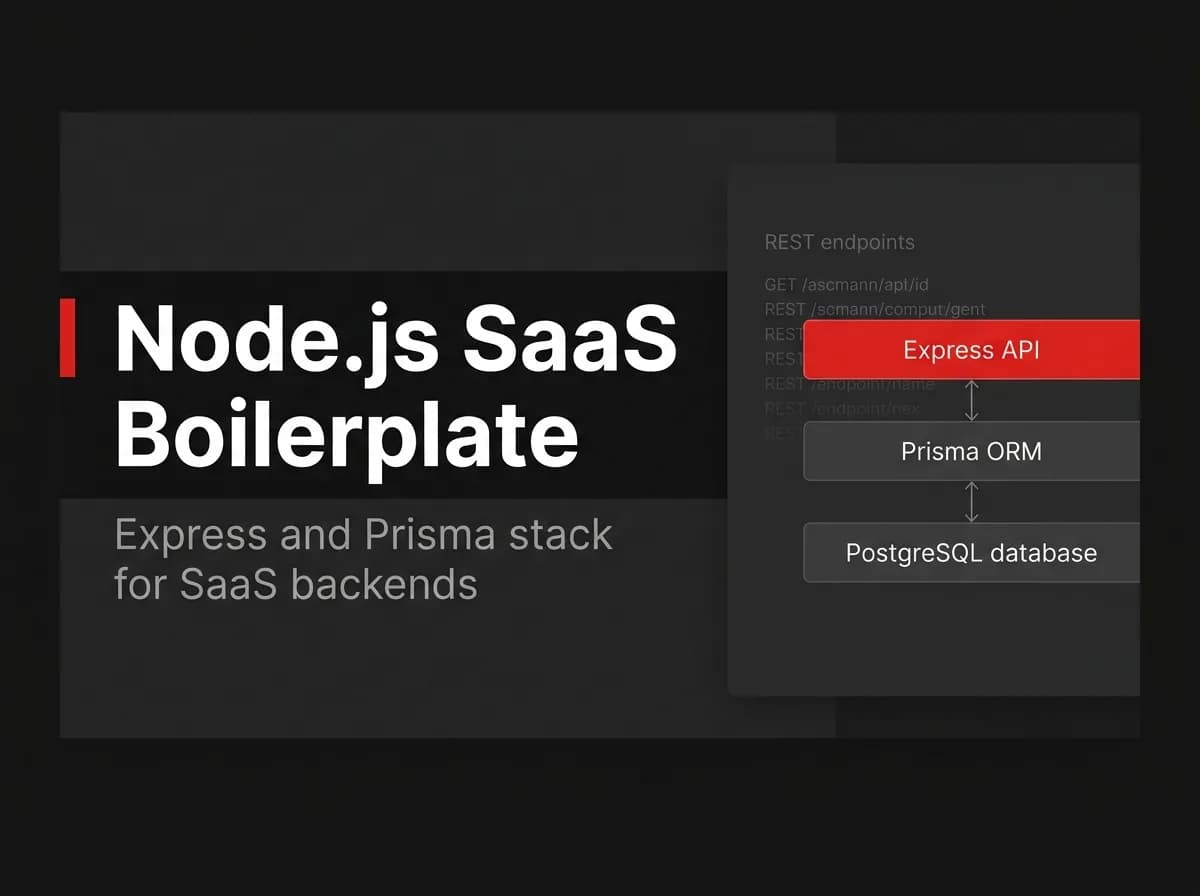
A Node.js SaaS boilerplate is a head start on the server side: an Express API, PostgreSQL with Prisma, a background job queue, auth, and billing, all wired together and ready to extend. Instead of spending weeks assembling these from scratch, you configure and build on top. Here's what a solid Node.js SaaS boilerplate includes — and why this stack still makes sense in 2026.
Quick Answer
A Node.js SaaS boilerplate is a ready-made backend — typically Express + TypeScript, an ORM like Prisma over PostgreSQL, plus authentication, billing, and a background job queue — so you start on your product instead of the plumbing. The best ones give you a real API server (not just serverless functions), a migration workflow, and code you own. Choose one whose stack matches your team.
What a Node.js SaaS boilerplate is
It is a starter codebase for the server side of a SaaS: an HTTP API, a database layer, auth, payments, and async workers, wired together and ready to extend. It saves the weeks you would spend assembling these from scratch.
The stack
Layer | Technology | What it gives you |
|---|---|---|
API server | Express + TypeScript | Routes, middleware, a typed backend |
Database | PostgreSQL + Prisma | Typed queries and safe migrations |
Background jobs | BullMQ + Redis | Async work (emails, webhooks, schedules) |
Auth | Sessions/OAuth/magic link | Login without renting a provider |
Billing | Stripe / Lemon Squeezy | Subscriptions and one-time payments |
Storage | S3-compatible (R2) | File uploads |
Why Express + Prisma
Express is the most widely known Node server framework, so the patterns and hiring pool are deep. Prisma gives you a typed client and a clear migration workflow over Postgres, which keeps schema changes safe as the app grows. Together they are a productive, well-understood backend foundation.
Build vs buy
Assembling auth, billing, jobs, and a database layer yourself is hundreds of hours before any product work. A boilerplate collapses that to a working backend you customize — the trade-off is adopting its conventions.
How this maps to FastStaq
FastStaq's backend is exactly this stack: a dedicated Express + TypeScript API (server/src), PostgreSQL via Prisma with migrations, BullMQ workers on Redis for background jobs, and S3/R2 storage — plus its own auth and Stripe/Lemon Squeezy billing. You own the code as a one-time lifetime package. See what a SaaS boilerplate is and the best Next.js boilerplates.
Frequently asked questions
Is Express still a good choice in 2026? Yes — it is mature, widely known, and pairs well with TypeScript and Prisma for a SaaS backend.
Why Prisma over raw SQL? Prisma adds type safety and a migration workflow; you can still drop to SQL when needed.
Do I need a separate API server? It is the better choice when you run background jobs, realtime, or a shared API for multiple clients.
Next steps
Compare the best Next.js boilerplates